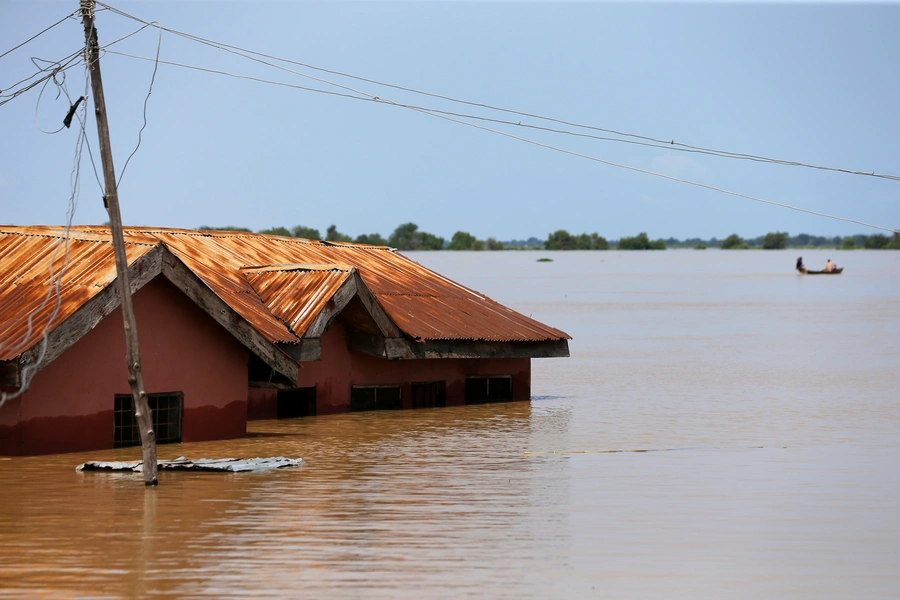
A development expert, Engr. Michael Ale, has called on the Ekiti State Government to urgently seek World Bank and Federal Government intervention to end the perennial flooding ravaging the state. This call comes after Monday's flooding that reportedly swept away residents at Ureje, Elemi, Odo-Ado, and Faglo areas of the state capital. Ale, an expert in water resources management, made the call in a statement on Tuesday in Ado-Ekiti.
Ale suggested that the government assemble a team of intellectuals from tertiary institutions in the state to draft a bankable proposal for a holistic flood control project. He cited the World Bank-assisted project that permanently solved the Ibadan flooding as an example. According to him, while weather forecasting is good, it must be matched with proactive measures. The announcement enlightening people on cautionary steps should be made much earlier, not when the rainy season starts.
The expert urged residents not to dare floodwaters during heavy downpour. He stressed that the state government can set up a committee of experts who will work on a very big project that would address the flood issue holistically. Ale also emphasized the need for strong institutional frameworks, strict building control to prevent construction on waterways, and strict adherence to the state's development master plan.
Ekiti has a 30-year Development Plan that lists flood control and environmental resilience as pillars, but lacks Monitoring and Evaluation, M&E. Ale noted that development without M&E is a press statement. Every flood in Ado-Ekiti is a violation of the State Development Plan, but there is no quarterly dashboard that says: Elemi dredging: Not Done. Ureje desilting: 40% Done.
Ale proposed that the Ekiti State House of Assembly should pass a Flood Resilience and Urban Planning Enforcement Law. This law would make annual dredging of Ureje and Elemi rivers mandatory before March, create 50-metre no-build buffer zones along rivers, and criminalize building without drainage clearance. He queried that flood in Ado-Ekiti is predictable, yet it happens yearly because there is no institutional framework that enforces consequences.
The expert called for an autonomous flood control agency with World Bank/AfDB partnership and five-year ring-fenced funding. He also suggested a statutory M&E agency reporting to the House of Assembly to publish quarterly compliance reports. Ale emphasized that development does not come from good leaders, but from strong institutions.
Ale concluded that with strong institutions, even a bad leader is confined to a system that benefits the masses. The flood that washed away residents did not happen because the leader is bad, but because the institution that should have stopped it does not exist or exists only on paper. The Ekiti State Government has yet to comment on the expert's suggestions.
Key points
- Expert urges Ekiti State Government to seek World Bank and Federal Government intervention to end perennial flooding
- Ekiti has a 30-year Development Plan that lists flood control and environmental resilience as pillars, but lacks Monitoring and Evaluation
- Expert proposes Flood Resilience and Urban Planning Enforcement Law to address flood issues holistically