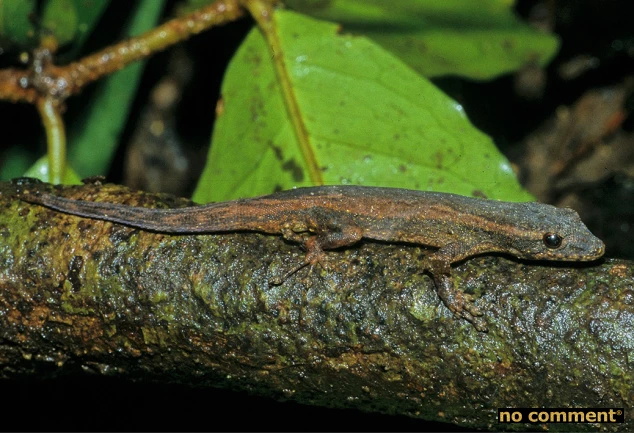
A team of Malagasy and international researchers has made a groundbreaking discovery in Madagascar, identifying eight new species of Lygodactylus geckos. This remarkable find was announced in the latest issue of the Zootoxa journal. The newly discovered species belong to the Domerguella subgenus and are characterized by their small size, with most measuring no longer than an index finger. The geckos have a grey and brown marbled appearance, distinguishing them from their colorful Phelsuma cousins.
According to Dr. Mark Scherz, a curator at the Natural History Museum of Denmark specializing in reptiles and amphibians in Madagascar, the Domerguella subgenus is exclusive to Madagascar. Prior to this discovery, researchers believed there were only five species of Domerguella, with three found in the tropical forest and two micro-endemic species in the north of the island. However, the recent findings have revealed a much greater diversity within this group, with estimates suggesting there may be up to 17 species.
The newly discovered species include Lygodactylus salvi, found in the Sambirano region in northern Madagascar; L. tantsaha, discovered in the Montagne d'Ambre in the far north; L. roellae, characterized by its colorful stripes; L. winki, also from the north; L. ulli, primarily found in the Marojejy massif in the northeast; L. fritzi, discovered in the coastal forest of the east; L. hodikazo, collected in the Tsingy de Bemaraha; and L. hapei, identified by its striped pattern on the neck, found in the Sambirano region.
One of the newly discovered species, L. fritzi, is particularly notable for its small size, measuring only 53 mm in length, making it the third smallest Lygodactylus species after L. broadlevi and L. roavolana. It is also one of the 50 smallest known vertebrate amniotes. Professor Miguel Vences, a herpetologist at the University of Brunswick in Germany, described the discovery as remarkable, especially given that four closely related species were found in the same location on Montagne d'Ambre, with no apparent interbreeding.
The discovery of these new species highlights the exceptional biodiversity of Madagascar. The fact that four closely related species can coexist in the same location without interbreeding is unusual, even for Madagascar, known for its unique fauna. Dr. Fanomezana Ratsoavina, a researcher at the University of Antananarivo, emphasized the importance of continuing to work to discover, describe, and assess the conservation status of Madagascar's wildlife.
Unfortunately, the newly discovered geckos are already listed as threatened with extinction. The researchers stress the need for conservation efforts to protect these species and their habitats. The discovery of these eight new species of Lygodactylus geckos is a significant addition to the understanding of Madagascar's fauna and highlights the importance of continued research and conservation efforts.
The research team included experts from Madagascar and international institutions, demonstrating the importance of collaboration in scientific discovery. The findings were published in the Zootoxa journal, a leading publication for research on zoology and taxonomy. The discovery of these new species will contribute to a better understanding of the evolution and diversity of Lygodactylus geckos in Madagascar.
Key points
- Eight new species of Lygodactylus geckos have been discovered in Madagascar, a record for the country.
- The newly discovered species belong to the Domerguella subgenus and are characterized by their small size and grey and brown marbled appearance.
- The discovery highlights the exceptional biodiversity of Madagascar and the need for continued research and conservation efforts.