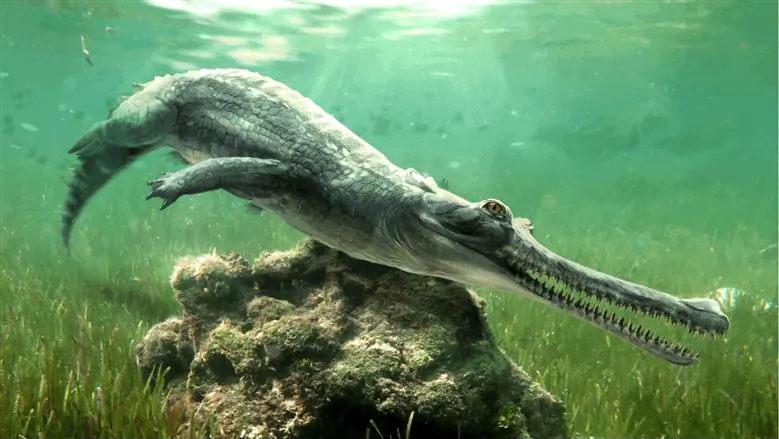
Egypt's Mansoura University has made a significant discovery in the field of paleontology, contributing to an international study that has identified a new species of crocodile, Hirgafialis, from a 45 million-year-old fossil found in Egypt. The fossil, initially discovered in 1927 in the Mokattam Hills, has been re-examined using modern scientific tools, revealing it to be a previously unknown genus of crocodile. This breakthrough was announced by Dr. Sherif Khatter, President of Mansoura University.
The study, published in the Royal Society Open Science journal, was conducted by a team of researchers from Mansoura University's Vertebrate Paleontology Center, led by Dr. Hisham Salam. The center's involvement in this international project highlights the university's commitment to specialized scientific research and its efforts to support researchers and scientific centers. This achievement demonstrates Egypt's contribution to global scientific knowledge and underscores the importance of continued investment in research and development.
Dr. Sherif Khatter emphasized that this discovery aligns with Egypt's strategy to support scientific research and innovation, as well as the Ministry of Higher Education and Scientific Research's efforts to enhance the country's research capabilities. The study's findings are a testament to the significance of collaboration between Egyptian and international scientific institutions in advancing our understanding of the natural world.
The fossil, previously known as Tomistoma cairensis, has been reclassified as Hirgafialis cairensis, following a comprehensive analysis of its anatomical and evolutionary characteristics. This reclassification was made possible through advanced imaging techniques and comparisons with other known crocodile species. The study's results provide valuable insights into the evolutionary history of crocodiles in Egypt and North Africa.
According to Dr. Hisham Salam, the discovery of Hirgafialis sheds new light on the evolutionary relationships between ancient crocodile species in the region. The study's findings have significant implications for our understanding of the paleontological history of the Mediterranean region and highlight the importance of continued exploration and research into Egypt's rich fossil heritage.
The research team used advanced scientific tools to examine the fossil, which is currently housed at the Stuttgart State Museum of Natural History in Germany. By digitally reconstructing the fossil's internal structure and conducting detailed anatomical comparisons, the team was able to determine that Hirgafialis represents a distinct genus within the crocodile family.
This groundbreaking discovery is a testament to the importance of interdisciplinary collaboration and the continued investment in scientific research. The study's findings are expected to contribute to a deeper understanding of the evolution and diversity of crocodile species, and Mansoura University's Vertebrate Paleontology Center is poised to play a leading role in future research endeavors.
Key points
- A 45 million-year-old fossil of a new crocodile species, Hirgafialis, has been discovered in Egypt.
- The study was conducted by a team of researchers from Mansoura University's Vertebrate Paleontology Center, in collaboration with international scientists.
- The discovery provides new insights into the evolutionary history of crocodiles in Egypt and North Africa.