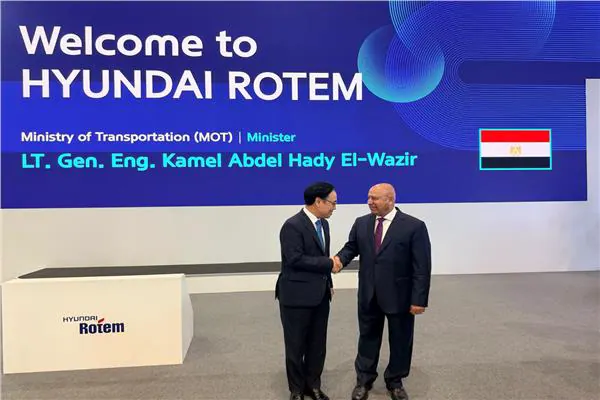
Egyptian Transport Minister, Kامل الوزير, participated in the "Inno Trans" transportation conference in Berlin, where he inspected various international and local company booths collaborating with the Egyptian Ministry of Transport on multiple projects. He reviewed the latest technologies and solutions offered by these companies and discussed updates on ongoing projects and future cooperation areas. This visit showcases Egypt's commitment to enhancing its transportation infrastructure through partnerships with global industry leaders.
During the conference, الوزير met with بونجبي لي, CEO of Hyundai Rotem, to discuss enhancing cooperation on several projects, including the manufacture and delivery of 30 tram units, complete with spare parts and maintenance for eight years. They also reviewed progress on localizing and manufacturing 320 metro cars for the second and third lines in collaboration with Hyundai Rotem and Nerak. Furthermore, they touched upon the development of signaling and communication systems on the Najaa Hamadi/Al-Qusayr line, spanning 118 km. Emphasis was placed on adhering to the specified timelines for these projects.
الوزير also held discussions with فاليريانو ساشيسيا, Chairman of the Board of Salini Impregilo, regarding the progress of work by Salini Track, a company owned by the Egyptian National Railway Authority and Salini. The focus was on renewal work on the Egyptian rail network, particularly after Salini received 30 pieces of equipment, including a complete renovation train and the establishment of a welding workshop in Tanta. The minister stressed the importance of the company adhering to the project's timeline.
In another meeting, الوزير met with خوسيه أنطونيو, Chairman of the Board of Talgo, a Spanish global company. The minister praised the fruitful cooperation with Talgo, which has supplied six luxury passenger trains that have entered service, providing high levels of service to passengers. Additionally, a contract was signed between the Egyptian Railway Authority and Talgo for the manufacture and supply of seven new luxury sleeper trains. The minister emphasized that this deal would support the current fleet of sleeper trains and significantly enhance services for tourism.
The minister further highlighted the significance of this agreement in supporting Egypt's tourism industry, both domestically and internationally. By upgrading the sleeper train services, the government aims to increase the number of trips on these lines, stimulate domestic tourism, and meet the growing demands of the railway sector. This development is expected to contribute to economic growth and provide better services to passengers.
In his meeting with كولومير, Chairman of the Board of Coluay, الوزير followed up on the cooperation between the two parties in developing sleeping cars. The Egyptian National Railway Authority and Coluay had previously signed a contract to develop 65 sleeping and dining cars at the company's workshop in Kom Abu Rudi. So far, 34 cars have been completed, and the minister stressed the need to adhere to the timeline for completing the remaining cars.
In press statements on the sidelines of the conference, الوزير asserted that Egypt is moving rapidly to implement and develop its transportation network in collaboration with major global and local companies. He emphasized that adhering to project timelines, speedy execution, quality of implementation, and localizing industry represent fundamental constants in all Ministry of Transport projects. This approach aims to build a sophisticated industrial base capable of meeting local market needs and expanding exports in the future.
Key points
- The Egyptian government is prioritizing the development of its transportation infrastructure through partnerships with global industry leaders.
- Adhering to project timelines and localizing industry are key priorities for the Egyptian Ministry of Transport.
- The development of the transportation sector is expected to contribute to economic growth and enhance services for passengers.