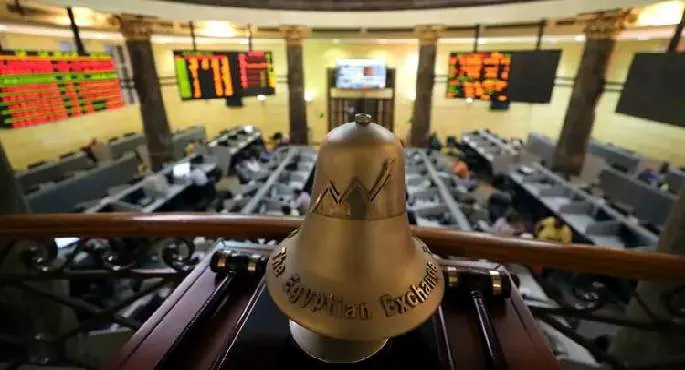
The Egyptian stock market witnessed a collective decline in its indices at the close of trading on Monday, September 21, 2026. This downturn was primarily driven by selling activities from foreign and Arab institutional investors, as well as individual foreign and Egyptian investors. Conversely, local institutional investors and Arab individual investors tended to lean towards buying.
The market capitalization of listed companies on the Egyptian stock exchange lost approximately 37 billion Egyptian pounds by the end of trading, dropping to 4.337 trillion Egyptian pounds. The total trading value reached around 71.1 billion Egyptian pounds, including transactions in bonds, treasury bills, and ownership transfer deals. The stock market's trading value specifically amounted to about 12.9 billion Egyptian pounds.
The main index of the Egyptian stock market, EGX 30, decreased by 0.68%, reaching 54,994.31 points. The small and medium-cap index, EGX 70, fell by 2.77% to 20,480.58 points. The broader EGX 100 index also declined by 2.29%, settling at 26,999.44 points. These movements reflect a general downturn in the Egyptian stock market during the session.
The decline in the Egyptian stock market is attributed to the selling pressure from foreign and Arab investors. Despite this, some buying interest was observed from local and Arab individual investors. Market participants are closely monitoring the situation to gauge the impact of these movements on the overall performance of the Egyptian economy.
The Egyptian government and regulatory bodies have been working to enhance the investment climate and attract more foreign investment. However, market volatility remains a challenge. The stock market's performance is closely watched by investors and analysts, who seek to understand the underlying factors driving these trends.
In recent months, the Egyptian economy has faced several challenges, including fluctuations in the stock market and currency exchange rates. The government has implemented various measures to stabilize the economy and promote growth. The stock market's reaction to these developments is a key indicator of investor sentiment.
The Egyptian stock market is expected to continue experiencing fluctuations in response to both local and global economic developments. Investors are advised to stay informed and exercise caution when making investment decisions. The market's performance will likely be influenced by a range of factors, including economic indicators, political developments, and global market trends.
Key points
- The Egyptian stock market indices declined collectively at the close of trading on Monday, driven by selling from foreign and Arab investors.
- The market capitalization of listed companies lost approximately 37 billion Egyptian pounds, dropping to 4.337 trillion Egyptian pounds.
- The main index, EGX 30, decreased by 0.68%, while the EGX 70 and EGX 100 indices fell by 2.77% and 2.29%, respectively.