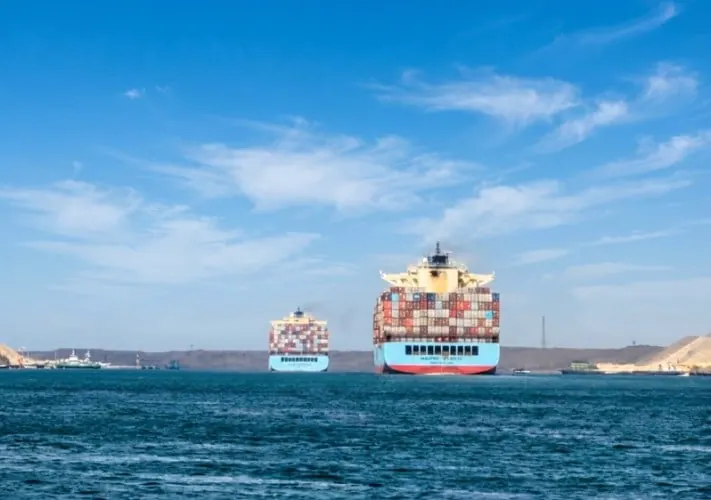
Egyptian shipping lines are resuming their use of the Suez Canal at a faster pace than expected, despite the limited economic benefits compared to the Cape of Good Hope route and ongoing security risks in the Red Sea. According to an analysis by Drewry, a shipping research firm, a container ship with a capacity of 24,000 twenty-foot equivalent units (TEU) operating on the Asia-Europe line through the Suez Canal in both directions will achieve a saving of around $1 million per round trip.
However, this estimate does not take into account war risk insurance premiums or potential discounts that may be offered by the Suez Canal Authority, which could significantly change the calculations. Drewry estimates that for a container ship worth $225 million, a war risk insurance premium of 0.3% of the vessel's value would add around $1.35 million to the cost of a round trip. If the premium rate is 1%, the additional cost would rise to $4.5 million, making the Cape of Good Hope route more economically viable.
In contrast, a 15% discount on Suez Canal tolls would represent a saving of around $365,000 for a round trip by a ship with a capacity of 24,000 TEU. Drewry notes that discounts of up to 25% have been observed, which could increase the potential saving to around $600,000. The firm's analysis suggests that the decision to return to the Suez Canal is driven by strategic considerations related to capacity, fleet utilization, transit times, and network competitiveness.
The Cape of Good Hope route adds thousands of nautical miles and around a week or more of sailing time in each direction. By returning to the Suez Canal, large-capacity ships can complete more annual trips while reducing the number of vessels needed to maintain weekly service frequencies. Drewry emphasizes that time has significant value for shipping companies, as shorter transit times enhance asset efficiency and improve the economic viability of the service.
Moreover, the reliability of schedules is another important factor, as the longer route around Africa increases the likelihood of bad weather and delays. Shipping companies may be willing to concentrate risks at the Bab al-Mandab Strait in exchange for mitigating multiple operational risks associated with the much longer route. The analysis also highlights competitive dynamics, as companies that return to the Suez Canal can offer faster transit times and similar prices, putting pressure on competitors to follow suit.
Drewry expects the return to the Suez Canal to have started in July and August 2026, with transit volumes reaching 80% of pre-diversion levels by February 2027 and remaining at this level throughout the forecast period. However, the consultancy warns that this return does not imply a complete return to normal security conditions, as the threat that initially prompted shipping companies to avoid the Red Sea has not disappeared.
The situation off the coast of Yemen remains a source of uncertainty, and risks are unevenly distributed. Drewry notes that while millions of dollars in savings can be absorbed within the results of a global network, a single successful attack on a container ship could result in human losses, cargo losses, prolonged operational disruptions, and significant reputational damage. As a result, the decision to return to the Suez Canal is no longer simply a matter of determining which route is cheaper; rather, it involves balancing the annual value of restored capacity, reduced transit times, and increased network efficiency against the potential cost of any new security disruption.
Key points
- Egyptian shipping lines return to Suez Canal despite security risks
- Limited economic benefits compared to Cape of Good Hope route
- Ongoing security risks in Red Sea and Gulf of Aden remain a concern