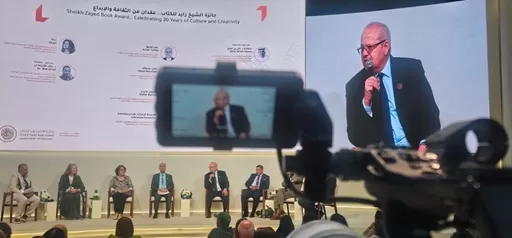
Egyptian thinker Mohamed Othman El-Khosht, a member of the Higher Scientific Council at Mohamed bin Zayed University for Humanities and former president of Cairo University, highlighted the significance of understanding religions from within during a session at the Abu Dhabi International Book Fair. The session, titled "Zayed Book Award: Two Decades of Culture and Creativity," took place on the main stage "Don Quixote" and was moderated by Ali bin Tamim, Secretary-General of the Zayed Book Award and head of the Abu Dhabi Center for Arabic Language.
El-Khosht, who won the "Manuscripts, Encyclopedias, and Dictionaries" category for his "World Religions Encyclopedia," issued in six volumes by Mohamed bin Zayed University for Humanities, emphasized that one of the most serious methodological mistakes in studying religions is judging a religion using the logic of another. He pointed out that each religion has its internal structure and specific concepts, and ignoring this specificity can lead to a distorted image of the other.
El-Khosht explained that the mistake begins when questions derived from the structure of one religion are posed to another, citing concepts such as the creator God, prophecy, revelation, and holy book, which do not hold the same position in all religious traditions. He gave the example of a researcher entering Buddhism with questions entirely derived from the structure of biblical religions, asking: "Who is the Buddhist God? Who is their prophet? What is their revealed book?"
The scholar noted that these questions do not belong to the center of the Buddhist experience, which revolves around liberation from suffering and the cycle of birth and death. He added that the same applies to other religious traditions, each having its own concepts and methods for understanding humanity, the world, salvation, and religious practice. El-Khosht warned that this flaw is not limited to understanding distant cultures but can also occur in understanding close religions.
El-Khosht stressed that doctrinal concepts should first be understood as defined by their adherents before being compared to concepts from other religious traditions. He stated that the methodological approach adopted by the encyclopedia involves a clear order of steps: "Understanding from within first, then analysis, then comparison." He added that much of the misunderstanding between peoples and cultures begins when we judge others by our standards before learning the standards by which they understand themselves.
The scholar cited the experience of Abu al-Rayhan al-Biruni in his book "The Incoherence of the Incoherence," where he learned Sanskrit, consulted Hindu sources, and sought to present their beliefs and sayings as they understood them. El-Khosht highlighted that the importance of al-Biruni's experience lies in presenting understanding before judgment and presenting the other through their sources and concepts, an approach that intersects with recent trends in studying religions that call for suspending preconceived judgments.
El-Khosht also mentioned that the "World Religions Encyclopedia" came in response to an Arab need for a study of religions using an approach that combines scientific accuracy and broad vision. He noted that previous studies relied on translations from foreign encyclopedias or traditional books on religions, which, although important in their time, were produced in different contexts and with the tools of their era, and did not know many of the religions and movements we know today.
Key points
- Understanding religions through their own lens is crucial for accurate knowledge and peaceful coexistence.