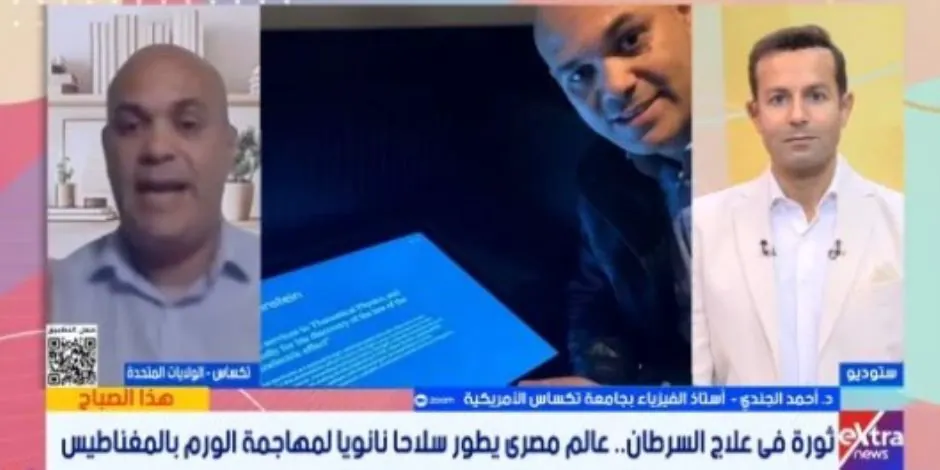
Dr. Ahmed Elgendi, an Egyptian researcher and physics professor at the University of Texas, has revealed a groundbreaking study on a novel cancer treatment that utilizes magnetic nanoparticles to target cancer cells. This innovative approach differs from traditional heat-based treatments, instead employing a mechanical effect within cells using an external magnetic field. In an interview with the TV program "This Morning" on Extra News, Dr. Elgendi discussed the promising results of his research in animal models of breast and prostate cancer.
The technology involves injecting tumors with extremely small magnetic particles that settle within the tumor and cancer cells. An external magnetic field is then applied, generating a mechanical force and torque on the particles inside the cells. This can cause disruption to the cell membrane of cancer cells, ultimately leading to their destruction. Unlike conventional magnetic hyperthermia treatments, this method does not rely on generating heat to kill cancer cells, and it has shown potential with lower doses of nanoparticles.
Dr. Elgendi's research team has achieved encouraging results in animal models of breast and prostate cancer, with a notable decrease in tumor size observed during follow-up. The animal trials involved exposing tumors to the magnetic field for approximately 20 minutes per session, twice a week, resulting in a significant reduction in tumor size within about four weeks. While these findings are promising, they are still in the animal trial stage and do not imply that the technology is yet available as a treatment for cancer patients.
The research has the potential to expand beyond its current scope, with Dr. Elgendi suggesting that magnetic nanoparticles could be developed to serve as a means of delivering drugs directly to cancer cells. By loading therapeutic drugs onto the surface of nanoparticles, it may be possible to combine targeted drug delivery with the mechanical effect of the magnetic field, offering a more comprehensive treatment approach.
According to Dr. Elgendi, this technology may be applicable to various types of solid tumors, not just breast and prostate cancer. His team is currently investigating other cancer cells, including those associated with different organs. However, the transition to clinical trials in humans is still in the distant future, requiring further research, larger animal trials, and regulatory approvals.
Dr. Elgendi emphasized that several factors must be addressed before clinical trials can begin, including securing necessary funding and meeting regulatory requirements. As such, it is challenging to predict a specific timeline for the initiation of clinical trials. The research team's next steps will involve conducting additional studies to confirm the technology's efficacy and safety.
The innovative cancer treatment using magnetic nanoparticles has generated significant interest in the medical community, with potential implications for the future of cancer therapy. Dr. Elgendi's work is a testament to the advancements being made in the field of cancer research, and his team's findings may ultimately contribute to the development of more effective and targeted treatments for this disease.
Key points
- A new cancer treatment using magnetic nanoparticles has shown promise in animal trials, according to Dr. Ahmed Elgendi, a physics professor at the University of Texas.
- The technology involves injecting tumors with extremely small magnetic particles that settle within the tumor and cancer cells, generating a mechanical force and torque on the particles inside the cells.
- The research has the potential to expand beyond its current scope, with Dr. Elgendi suggesting that magnetic nanoparticles could be developed to serve as a means of delivering drugs directly to cancer cells.