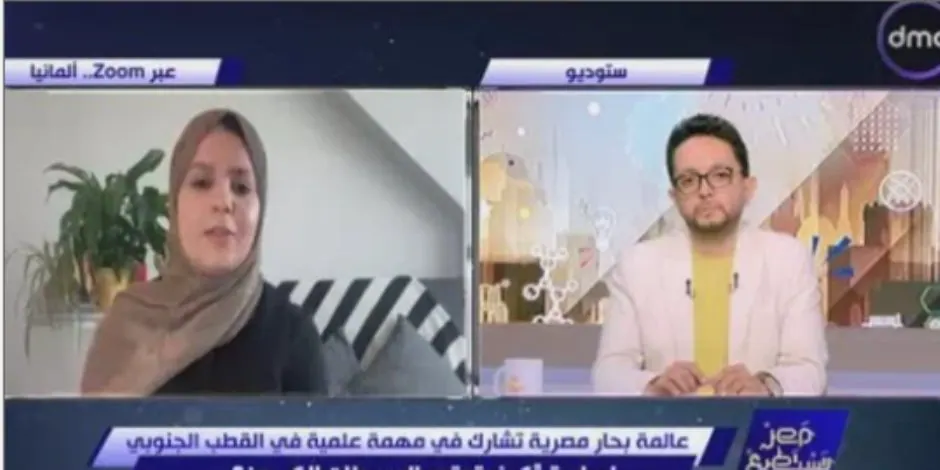
Dr. Marwa Mahmoud, a marine scientist from Alexandria, Egypt, has achieved a significant milestone as the first Egyptian, Arab, and African woman to participate in scientific research in Antarctica. She was part of a two-month and eight-day expedition on a German research vessel. The team consisted of approximately 31 researchers, 45 crew members, engineers, and technicians. Europeans made up around 90% of the participants, representing countries such as Germany, Britain, Belgium, and France, as well as China.
The expedition provided Dr. Mahmoud with a unique opportunity to explore the Antarctic environment, which she described as a "world full of life" with diverse ecosystems on and beneath the ice and in the depths of the oceans. She noted that the region is home to various creatures, including penguins, whales, and birds, thriving in an isolated environment. The scientist highlighted the significant changes observed in the marine ecosystem and the interconnectedness of the environment.
During the expedition, the team relied entirely on the vessel's supplies, as all forms of fishing and hunting are prohibited in Antarctica to protect the environment. Dr. Mahmoud emphasized the importance of preserving the delicate ecosystem and the need for scientific research to inform decision-making. Her experience on the expedition has contributed to her current project, which focuses on studying "blue carbon" along Egypt's coastlines.
Dr. Mahmoud is currently working on a project in collaboration with a German institute to study blue carbon in Egyptian marine environments, such as mangrove forests, seagrass beds, and wetlands. The project aims to measure the carbon sequestration capacity of these ecosystems and promote their rehabilitation. By applying scientific knowledge, the goal is to support informed decision-making for coastal protection and climate change adaptation.
The research vessel, which was funded by Germany, brought together scientists from various countries, including Dr. Mahmoud, who represented Egypt and Africa. Her participation in the expedition marks a significant milestone for Egyptian and Arab women in science. Dr. Mahmoud's achievement demonstrates the growing presence of African researchers in international scientific endeavors.
Dr. Mahmoud's experience in Antarctica has provided valuable insights into the impact of climate change on marine ecosystems. Her research focuses on understanding the complex relationships between the ocean, atmosphere, and ecosystems. By studying these interactions, scientists can better predict and mitigate the effects of climate change on coastal communities and ecosystems.
As Dr. Mahmoud continues her research, she aims to contribute to the development of sustainable solutions for coastal protection and management. Her work on blue carbon and ecosystem rehabilitation will help inform policy decisions and support the conservation of Egypt's marine resources. The researcher's groundbreaking achievement serves as an inspiration for young scientists, particularly women, to pursue careers in STEM fields.
Key points
- Dr. Marwa Mahmoud is the first Egyptian, Arab, and African woman to participate in scientific research in Antarctica.
- The expedition aimed to study the marine ecosystem and the impact of climate change on the Antarctic environment.
- Dr. Mahmoud is currently working on a project to study blue carbon in Egyptian marine environments and promote ecosystem rehabilitation.