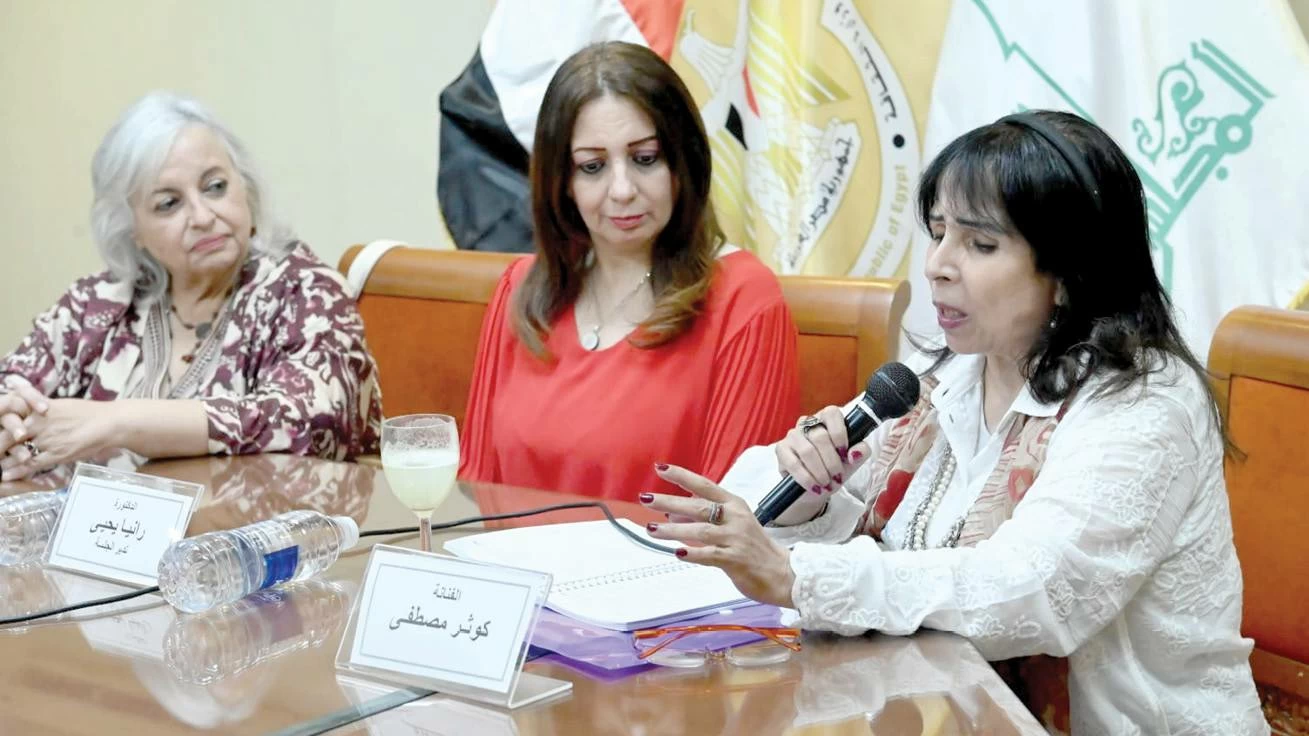
The first session of the "Testimonies" axis, titled "How did we escape the transparent wall?", was held as part of the fourth edition of the Isis International Festival for Women's Theater. The session brought together several theater makers to discuss their personal and professional experiences, as well as the challenges they faced during their artistic journeys. The session was moderated by Dr. Rania Youssef, Director of the Egyptian Academy of Fine Arts in Rome and former Dean of the Higher Institute of Critical Arts.
Poet Kuthar Mustafa spoke about her journey with creativity, explaining that overcoming the "transparent wall" in her life began in her childhood when she found reading and writing to be a special space that allowed her to express herself. Growing up in a family that adhered to traditions and customs made her search for a different way to discover herself. Mustafa mentioned that her upbringing and social environment formed a significant part of her human path.
Kuthar Mustafa indicated that discovering a book about expatriate poets was a turning point in her life, as she found models of creators who managed to overcome their circumstances and achieve their dreams. This led her to start her journey with reading and writing. She added that writing became the space where she found her freedom, as she began to search for books, read them, and write her first attempts in secret.
Mustafa reviewed her beginnings in theater before moving to write songs and work with several artists. She found that songs were a means to reach a wider audience in a short time. She pointed out that she focused on women's issues, human and social concerns, and presented around 130 songs, some of which achieved significant success with the voice of artist Mohamed Mounir.
During her discussion about her vision for the future, Kuthar Mustafa proposed the idea of presenting a new form that combines poetry and theater arts, which she called "poetry theater". She explained that transforming dramatic poems into theatrical performances could open a new space for poetry to reach the audience, using various theater elements such as music, lighting, decoration, and clothing.
The poet emphasized that science, determination, and enthusiasm were the tools that helped her continue despite challenges, noting that the idea of not breaking is present in many of her works, including songs she wrote that carry messages of strength and continuing the path. Mustafa also discussed her vision of language and writing, stressing that she sees no difference between formal and colloquial poetry or between a poem and a song.
Kuthar Mustafa participated in the festival alongside other notable figures, including Dr. Niveen Elulba and director Abeer Ali. The Isis International Festival for Women's Theater continues to provide a platform for women's voices and artistic expressions.
Key points
- Poet Kuthar Mustafa highlights the importance of women's issues and human concerns in her work.