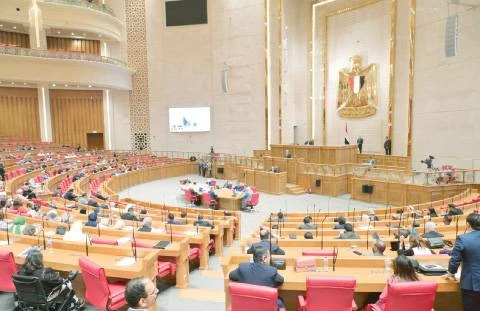
A group of nine Egyptian parliamentarians have taken a significant step by submitting an urgent parliamentary question to the government, calling for the immediate release of official poverty rates and the findings of the income-expenditure survey. This move comes ahead of the government's presentation of its achievements. The MPs, representing various political parties, emphasized the importance of this data in evaluating the government's performance.
The parliamentarians who initiated this move include prominent figures such as Irin Said, head of the parliamentary body of the Reform and Development Party, and Mohamed Fawad, head of the parliamentary body of the Justice Party. Other signatories to the question are Amira Adel, a member of the Coordinating Committee of Youth of Parties and Politicians, Sahar Atman, and Hussam Al-Khusht from the Justice Party, as well as Ahmed Farag and Ahmed Al-Sinjidi, who are independent MPs. Additionally, Rawya Muktar from the Reform and Development Party and Mohamed Abdel Hafiz, deputy head of the party's parliamentary body, have also joined the effort.
The MPs pointed out that the government has repeatedly pledged to send the income-expenditure survey to the parliament but has failed to fulfill this promise. They expressed their concerns about the lack of data, questioning how it is possible to assess the government's achievements without knowing the poverty rates in Egypt since 2021. This issue has sparked a debate about the government's transparency and accountability.
Irin Said stated that the government's response has consistently been that they would provide the data within a week, but this has yet to materialize. Amira Adel highlighted that several MPs used various parliamentary tools during the previous session to demand poverty figures, but the session concluded without the government honoring its commitments. Adel stressed the significance of poverty indicators in shaping policies, programs, and evaluating economic and social decisions.
The independent MP, Ahmed Farag, called for summoning the Prime Minister to discuss the data, figures, and promises made by the government before the parliament, which have not been implemented. This call for accountability reflects a broader demand for transparency and good governance. The issue has become a focal point of discussion within the Egyptian parliament.
The demand for the disclosure of poverty rates and income-expenditure data is seen as a critical step towards enabling a more informed assessment of the government's socio-economic policies. It also underscores the parliament's role in ensuring that the executive branch remains accountable to the people. The outcome of this initiative will be closely watched as it has implications for governance and policy-making in Egypt.
The Egyptian government faces mounting pressure to provide accurate and up-to-date socio-economic data. The release of this information is expected to facilitate a better understanding of the country's economic challenges and help in formulating effective strategies to address them. The situation remains a significant concern for both the government and the Egyptian public.
Key points
- The Egyptian government has been urged to disclose poverty rates and income-expenditure survey results since 2021.
- Nine parliamentarians from various political parties have submitted an urgent parliamentary question to the government on this matter.
- The lack of data has raised concerns about the government's transparency and its ability to assess its achievements accurately.