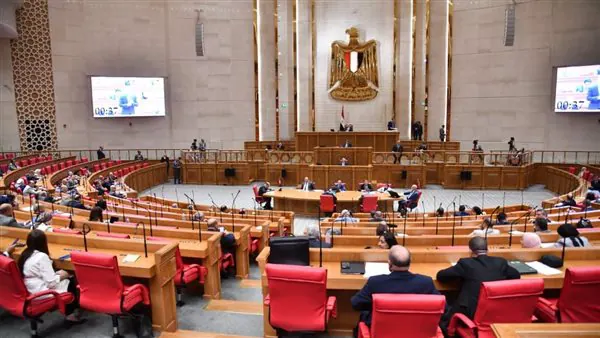
The Egyptian Parliament's general committee will discuss President Abdel Fattah El-Sisi's objections to a law establishing Kayan University for Applied Sciences. The law was passed but the President objected to Article 25, which grants allowances to students. The committee, led by the parliament's speaker, will study the objections and the Prime Minister's statement. This will take place once the committee is formed after the election of committee chairs and selection of party representatives.
The President's objections were submitted to the parliament during its inaugural session, led by Counselor Hesham Badawi. The parliament's general committee will comprise the speaker, two deputies, the general secretary, chairs of specialized committees, heads of parliamentary bodies, and representatives of independent MPs. The committee will also include the Minister of Parliamentary Affairs. The President objected to Article 25, which grants allowances to students, citing the need for equality among students in all universities.
Prime Minister Mostafa Madbouly presented a statement on the President's objections, highlighting that the article grants a monthly stipend to military students equivalent to the salary of a newly commissioned officer. The stipend is conditional on students completing their studies successfully. The Prime Minister's statement was submitted to the general committee for review. The committee's discussions will focus on the President's objections and the Prime Minister's statement.
According to the parliament's internal regulations, the general committee will review the objections and submit a report. The report will be discussed in a plenary session, and the parliament will decide whether to accept or reject the President's objections. If the parliament rejects the objections, the law will come into effect without needing the President's approval. The parliament's decision will be based on a two-thirds majority vote.
The internal regulations also state that if the parliament accepts the President's objections, a special committee will be formed to review and amend the law. The special committee will comprise members appointed by the parliament's speaker. The committee's recommendations will be submitted to the parliament for approval. The parliament's speaker will inform the President of the parliament's decisions and actions regarding the objections.
The Kayan University law aims to establish a leading research center and academic institution, aligned with international standards, to contribute to sustainable development. The university will offer applied sciences programs. The law's passage and the President's objections have sparked debate among lawmakers and stakeholders. The parliament's discussions will focus on balancing the need for academic excellence with the need for financial support for students.
The formation of the general committee is expected to be completed in the coming weeks, after the election of committee chairs and selection of party representatives. Once formed, the committee will begin reviewing the President's objections and the Prime Minister's statement. The committee's report will be submitted to the parliament for discussion and voting. The parliament's decision will determine the fate of the Kayan University law and its implementation.
Key points
- The Egyptian Parliament will review President Abdel Fattah El-Sisi's objections to a law establishing Kayan University for Applied Sciences.
- The President objected to Article 25, which grants allowances to students, citing the need for equality among students in all universities.
- The parliament's general committee will study the objections and the Prime Minister's statement, and submit a report for discussion and voting.