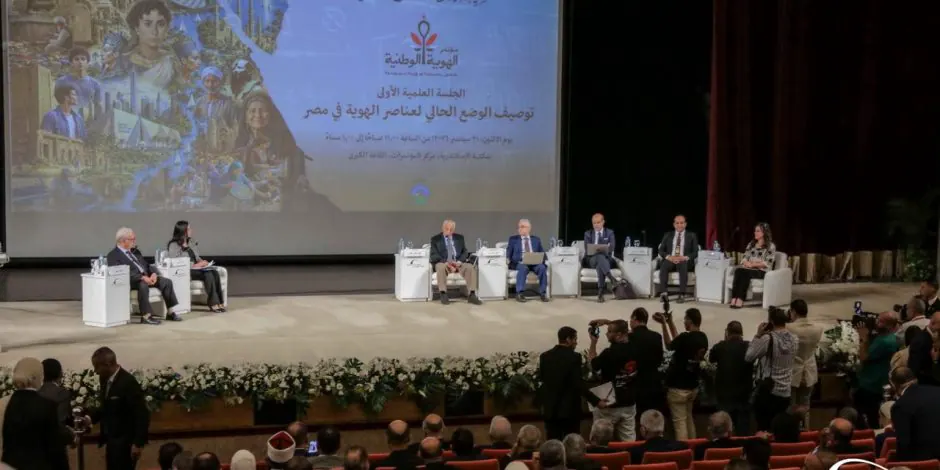
The Egyptian National Identity Conference, titled "National Identity: Rooted and Renewed," commenced at the Bibliotheca Alexandrina, under the auspices of President Abdel Fattah El-Sisi. The conference features a three-day program with the first session, "Describing the Current Status of Identity Elements in Egypt," led by Dr. Ali El-Din Helal, a professor of political science at Cairo University. The session included four research papers presented by experts.
Dr. Hussein Issa, Deputy Prime Minister for Economic Affairs, stated that Egypt's national identity is robust and not in crisis despite facing various pressures. He described national identity as a fixed yet dynamic concept, with its core values and ideas remaining constant while its manifestations evolve due to environmental, economic, and security changes. Dr. Issa highlighted that economic pressures have demonstrated the strength of Egyptian identity, particularly through remittances from Egyptians abroad during challenging times.
Dr. Maya Morsi, Minister of Social Solidarity, emphasized that national identity is not merely a heritage but a growing entity that expands with time and civilization. She discussed the changes in Egyptian identity over the past four decades, noting that it has faced significant disruptions due to external influences on fashion, ideas, and culture. Dr. Morsi stressed the importance of teaching the Egyptian Constitution's preamble in educational curricula, as it encompasses all elements of Egyptian identity.
Dr. Ali El-Din Helal initiated the session by defining national identity as the essence and meaning that distinguishes one nation from another. He identified the components and sources of identity as language, history, and cultural creativity, which connect individuals to their nation and community. The session featured research papers by Dr. Saeed El-Masry, Dr. Mazen Hassan, Dr. Youssef Wardani, and Dr. Mona El-Hadidi, each focusing on different aspects of Egyptian national identity.
Dr. Saeed El-Masry's paper, "Paradoxes of National Identity in Egypt," analyzed the social and cultural dimensions of national identity, highlighting the disparity between its perceived strength and its social and civic manifestations. Dr. Mazen Hassan's paper, "The Political Dimension of Egyptian Identity," concluded that there is no crisis regarding the strength of the political aspect of national identity in Egypt, citing a shared sense of patriotism and perceived external threats among Egyptians.
Dr. Youssef Wardani's paper focused on transformations in national identity among Egyptian youth, particularly Generation Z, in light of rapid economic, social, and cultural changes. He emphasized that effective policies to enhance national identity should provide younger generations with opportunities for understanding, participation, and contribution to decision-making. Dr. Mona El-Hadidi's paper, "The Egyptian Family and Identity Transformations in the Digital Age," highlighted the critical role of the family in preserving cultural identity.
The conference aims to explore and discuss the complexities of Egyptian national identity, its evolution, and its implications in the digital age. Key points include the resilience of Egyptian identity despite external pressures, the importance of education and family in shaping national identity, and the need for inclusive policies that engage younger generations in the nation's development.
Key points
- The conference is held under the auspices of President Abdel Fattah El-Sisi.
- The conference features research papers by prominent Egyptian academics and experts.
- The discussions focus on the roots and transformations of Egyptian national identity.