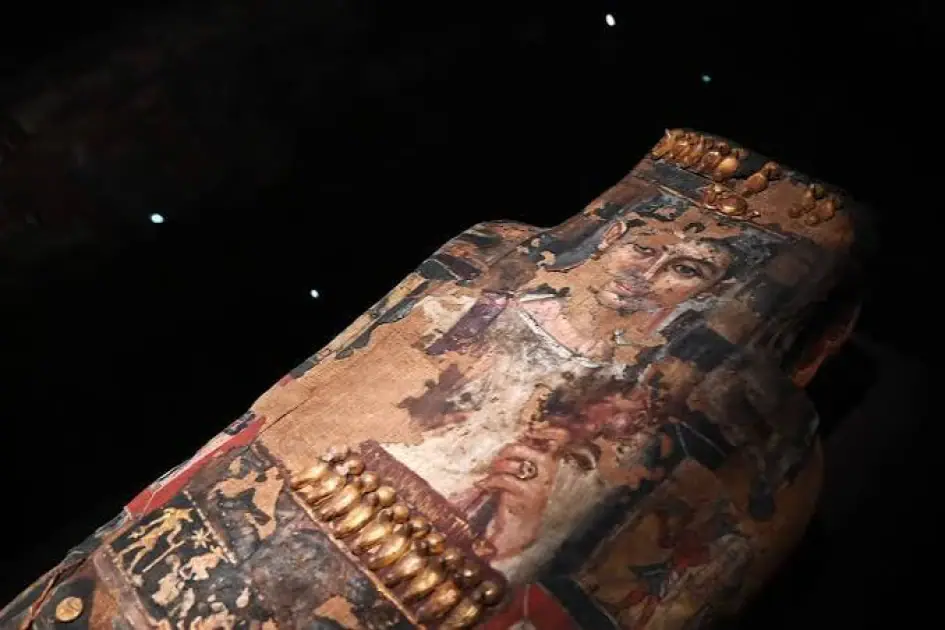
An exhibit featuring 2,000-year-old Egyptian mummy portraits has opened in Rome's Ara Pacis museum. The portraits, known as the "Faces of Fayum," are startlingly realistic funerary paintings created after Egypt became part of the Roman empire. They were painted on thin wooden panels and designed to be placed over the face of mummies. The exhibit, a collaboration between Italy and Egypt, includes mummies, masks, shrouds, jewelry, marble busts, and statuary.
The majority of the artifacts come from Egypt, with some allowed to leave the country for the first time. One of the notable works is the "Tondo of the Two Brothers" from Cairo's Egyptian Museum, a freshly restored double portrait from the time of Emperor Hadrian. The portrait depicts two curly-haired young men, possibly brothers, with soulful eyes. Rome's top official for cultural heritage, Claudio Parisi Presicce, called the work an "absolute masterpiece, perhaps the most important pictorial work to have survived from antiquity."
The portraits, rooted in the tradition of Hellenistic painting, come from a relatively brief period between the first and third centuries AD. They often bear Egyptian features but wear Roman dress. Their faces are vivid and haunting, whether bearing signs of greying hair and wrinkles or the long eyelashes and chubby cheeks of a child. Italian figurative painter Amedeo Modigliani once said of the Fayum portraits that "these people are not dead, they are more alive than those who gaze upon them."
The exhibit includes works from international museums such as the Louvre, the Metropolitan Museum of Art, and the J. Paul Getty Museum. A fertile area of Egypt on the edge of the desert, Fayum's arid climate helped preserve the delicate painted wood, textiles, and papyrus on display. One work, on loan from the Louvre, is a spectacular, near-pristine linen shroud depicting a man standing between the mummy he will become and Anubis, the jackal-headed god who helped usher the dead into the Afterlife.
Some of the female portraits are adorned in sumptuous jewelry, such as that of the woman "Isidora" from the first century AD. Her three-tiered gold necklace adorned with precious stones, pearl earrings, and elaborately curled hairdo project her status. Parisi Presicce said that "countless questions" remain about the compelling portraits, including whether they were made earlier and kept until the moment of death or painted at the time the deceased was buried.
Hisham El-Leithy, secretary-general of Egypt's Supreme Council of Antiquities, said the images from so long ago have an uncanny power to move us. "They are people like us, we look at them, they look back at you across 2,000 years," he said. "That is the power of the portrait." The exhibition runs until May 2.
The collaboration between Italy and Egypt is being hailed as a "milestone" exhibit. The exhibit showcases a fusion of two great civilizations, Egyptian and Roman. The portraits, with their naturalistic painting and vivid faces, are a testament to the artistic skill of the ancient civilizations.
Key points
- The exhibit features 2,000-year-old Egyptian mummy portraits from the Roman era.
- The portraits, known as the "Faces of Fayum," were painted on thin wooden panels and designed to be placed over the face of mummies.
- The exhibit runs until May 2 at Rome's Ara Pacis museum.