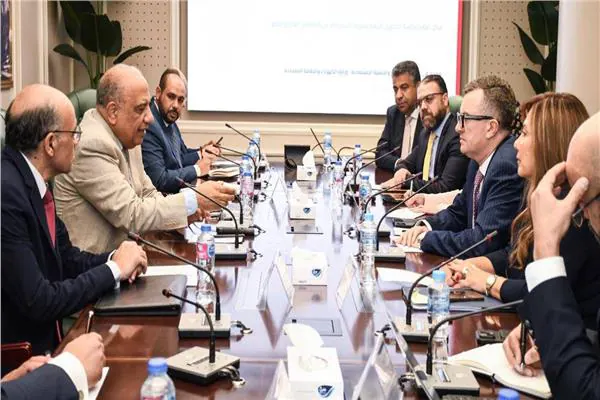
Egyptian Minister of Electricity and Renewable Energy, Dr. Mahmoud Essmat, met with Minister of Planning and Economic Development, Dr. Ahmed Restom, to discuss collaboration on seawater desalination projects. The meeting, held at the Ministry of Electricity's headquarters in the new capital, focused on optimizing the use of existing power plant infrastructure for desalination. Also in attendance were senior officials from the Nuclear Materials Authority, the National Investment Bank, and representatives from the consulting firm, ENI Consulting.
The ministers reviewed a joint plan of action, emphasizing the importance of coordination between their ministries. They examined preliminary economic and feasibility studies for utilizing power plants near the Red and Mediterranean seas for desalination. The discussions also touched on partnership models with the private sector and financing mechanisms. Several proposals from companies were presented, highlighting various technologies that could be employed.
A key aspect of the talks was the creation of economic entities to invest in extracting and separating salts and other valuable minerals. The ministers also explored projects for extracting rare earth elements and critical materials from local geological formations. This would involve cooperation with relevant authorities to maximize economic returns. The meeting further addressed ongoing electricity sector projects, focusing on securing developmental financing and technical support.
Minister Essmat emphasized the government's commitment to maximizing returns from existing assets, particularly power plants near coastal areas. He noted that expanding energy storage facilities aims to capitalize on renewable energy sources during peak times, reducing reliance on fossil fuels. Essmat also highlighted plans for extracting rare materials, underscoring their strategic importance and the economic benefits they could generate.
Minister Restom stressed that investing in infrastructure is crucial for sustainable economic growth and development across various productive sectors. He pointed out that renewable and clean energy projects, especially in the electricity sector, are top priorities for the state's investment plan. These initiatives are seen as essential for attracting investments and establishing a national industry.
The collaboration with ENI Capital and ENI Consulting, along with the National Investment Bank, aims to provide economic studies and feasibility assessments. This partnership seeks to secure affordable financing structures in conjunction with international financial institutions and the private sector. The goal is to develop a modern energy network that supports urban and industrial expansion while transitioning to a greener economy.
The discussions between the ministers reflect Egypt's broader strategy to enhance its energy infrastructure and promote sustainable development. By leveraging existing power plants for desalination and exploring new technologies, the country aims to address water scarcity challenges. The emphasis on public-private partnerships and international cooperation underscores the complexities of funding and implementing such large-scale projects.
Key points
- Egypt's government is prioritizing investments in renewable energy and infrastructure to drive sustainable economic growth.
- The collaboration aims to utilize existing power plant infrastructure for seawater desalination, reducing costs and environmental impact.
- The project includes exploring the extraction of valuable minerals and rare earth elements from geological formations.