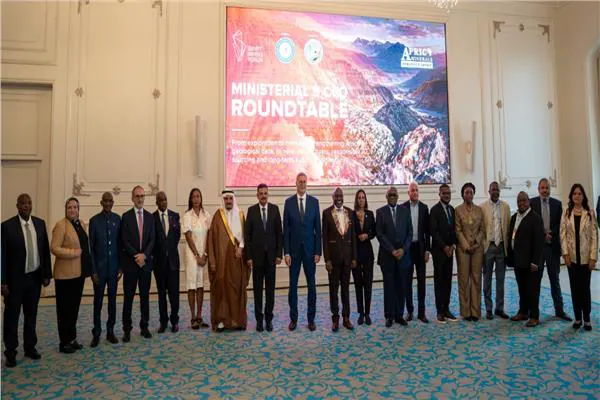
Egyptian Minister of Petroleum and Mineral Wealth, Karim Badawi, stated that his ministry is working to create an attractive investment environment for the mining sector. This includes encouraging global, regional, and local companies to enter and expand their investments in Egypt. The goal is to benefit from successful international experiences in developing and exploiting mineral wealth. Badawi made these remarks during a high-level roundtable discussion with ministers and CEOs from African and Arab countries.
The roundtable discussion, titled "From Exploration to Markets: Enhancing Mineral Value Chains in Africa," was held in preparation for the fifth edition of the Egypt Mining Forum. The forum is set to take place in the new capital city. Badawi emphasized that developing the mining sector requires enhancing cooperation between governments and investors. This can be achieved by adopting best practices and international expertise while establishing clear national frameworks for mineral wealth development.
Badawi highlighted the importance of attracting major global companies to participate in exploration, production, and long-term development of mining projects. He noted that maximizing the benefits of mineral resources requires not only extraction but also developing infrastructure, including roads, ports, communications, electricity, and energy. This enables the transition from exploiting raw materials to developing and manufacturing them, thereby increasing their value.
Tanzanian Minister of Minerals, Antoni Mavondy, stated that his country is adopting a vision to develop the mining sector. This vision involves transitioning from extracting and exporting raw materials to building integrated value chains that include processing and refining. Mavondy mentioned that Tanzania aims to increase its high-precision geological and geophysical surveys from 16% to 100% by 2030. This will provide a more accurate database, reduce investment risks, and identify critical and strategic minerals.
Kenyan Minister of Mining, Blue Economy, and Maritime Affairs, Hassan Ali Joho, emphasized the importance of enhancing dialogue and harmonizing mining policies at the continental and regional levels. This will provide more benefits for investors, governments, and people. Joho noted that African countries have common opportunities that can be developed collectively. He called for continued dialogue on mining policies and creating a supportive business environment for investment.
African Mineral Strategy Group (AMSG) Secretary-General, Moses Michel Ingado, stated that discovering mineral resources is just the starting point. The real challenge lies in converting these resources into productive projects that reach development, processing, and final market stages. Ingado emphasized that achieving this requires integrating multiple elements, including geological data, infrastructure, governance, energy, and technology.
The participants concluded that developing the African mining sector requires transitioning from extraction and exporting raw materials to building integrated value chains. This includes processing, manufacturing, and maximizing local value added. They also emphasized that attracting private capital and long-term financing is linked to clear and stable legislative and regulatory frameworks. The participants called for directing more financing tools towards early exploration stages and supporting emerging mining companies.
Key points
- The Egyptian Minister of Petroleum and Mineral Wealth emphasizes the importance of creating an attractive investment environment for the mining sector.
- Tanzanian Minister of Minerals aims to increase high-precision geological and geophysical surveys to 100% by 2030.
- The participants conclude that developing the African mining sector requires building integrated value chains that include processing and manufacturing.