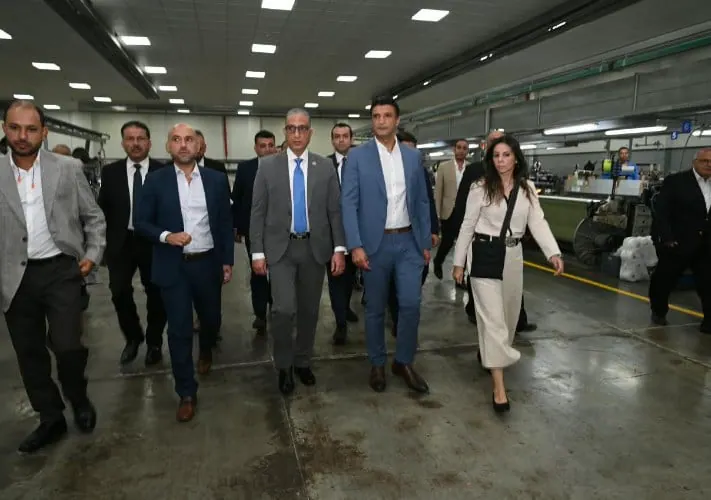
Egyptian Minister of Industry, Khaled Hashem, accompanied by Giza Governor, Ahmed El-Ansary, recently visited the Fourth Industrial Zone in Cairo's Sixth of October City. During the visit, they inspected two factories producing textiles, knitting, dyeing, printing, and finishing. The delegation included Maha Saleh, Assistant Minister of Industry for Industrial Policies, and Brigadier General Ihab Amin, head of the Industrial Control Authority.
The first factory, Naja Teks for Textile Industries, spans 5,000 square meters with an initial investment of 30 million Egyptian pounds and total investments of 300 million pounds. The factory has an annual production capacity of 1.44 million meters of fabric, with a local component of 90%. It exports 60% of its production, worth 2 million dollars, to Switzerland, Turkey, Germany, Brazil, and Italy. The company provides various textile products and has a showcase for its products.
During the visit, Minister Hashem was briefed on the production lines and various manufacturing stages at Naja Teks. He also met with Khaled Naja, Chairman of the Board of Directors. The minister emphasized that the textile industry is a priority in Egypt's industrial strategy, being a significant sector that can integrate into global supply chains and increase export opportunities.
The second factory, Egypt Al-Salam for Knitting, Dyeing, Printing, and Finishing, covers an area of 20,000 square meters with investments of 600 million pounds. It has an annual production capacity of 5,000 tons of dyed and printed fabric, with a local component of 80%. The company exports 20% of its production, worth 3 million dollars, to Turkey and Morocco. It provides 1,800 direct and indirect job opportunities.
At Egypt Al-Salam, Minister Hashem inspected various stages of production, including weaving, dyeing, and printing. He also visited the factory's exhibition and wastewater treatment plant. The company was represented by Mohamed Amjad, Chairman of the Board of Directors. The minister highlighted the importance of developing the textile industry and increasing its local component to enhance production and export competitiveness.
Giza Governor, Ahmed El-Ansary, praised the development in Egypt's industrial sector, citing efforts to create a favorable investment environment and facilitate production procedures. He expressed his hope for establishing diverse industrial communities in the governorate, including traditional industries and services, to support artisans and provide permanent markets for their products.
The visits showcased Egypt's efforts to boost its industrial sector, particularly in the textile industry. The government aims to increase exports, create jobs, and attract investments. The minister's tour demonstrated the importance of industrial development in driving economic growth and improving competitiveness.
Key points
- The Egyptian government is prioritizing the development of the textile industry to increase exports and create jobs.
- The visited factories demonstrate the potential for growth and investment in Egypt's industrial sector.
- The government aims to create a favorable business environment to attract investments and support industrial development.