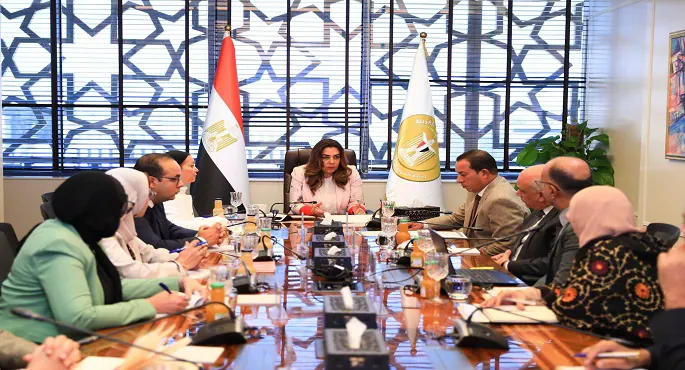
Egyptian Minister of Local Development and Environment, Dr. Manal Awad, recently chaired a meeting with the project team to discuss the production and use of beneficial microorganisms "EM". The project, a collaboration between the Ministry and Japan's EMRO research organization, began in Egypt in 2002. Its goal is to utilize beneficial microorganisms in agricultural and environmental development.
During the meeting, Dr. Awad heard a presentation on the "EM" substance, including its origin, nature, components, and mechanism of action. The minister learned about the various applications of "EM" in agriculture, industry, environment, tourism, and practical experiments conducted in Egypt. These experiments focused on wastewater and industrial waste treatment, waste management, water and soil quality improvement, and support for agricultural and fish farming applications.
Dr. Awad emphasized the importance of effective marketing for the "EM" product to introduce it to the public, highlight its benefits and applications, and enable it to compete in the market. She stressed the need to transition from experimental and application stages to a clear plan for expanding "EM" production and marketing. The minister also instructed the team to prepare a comprehensive plan to promote "EM", including simplified content for the public and target sectors.
The minister directed the team to provide trained and qualified technical personnel to handle "EM" production and applications. She also emphasized the need for a suitable site and well-equipped laboratory for "EM" production, ensuring a conducive environment for production and product quality. Dr. Awad instructed the formation of a specialized committee to oversee "EM" production, applications, and coordination among relevant authorities.
The project team reported that the current production capacity of "EM" is approximately 500 tons per year, manufactured within the project and at several industrial facilities. The project aims to support national goals, including water resource conservation, improved waste management, sustainable agricultural resources, and environmental pollution reduction. The team also presented various experiments focused on improving soil properties, increasing fertility, and supporting agricultural production.
Dr. Awad instructed the project team to prepare a periodic bulletin for governors to introduce "EM", its nature, benefits, and applications. This will facilitate the use of "EM" in addressing environmental challenges in various sectors. The minister also directed the team to identify requirements for production sites, equipment, personnel, and training to support expanded production and marketing of "EM".
The project has been producing "EM" since 2002, with applications in multiple sectors. Key points from the meeting include:
Key points
- Egypt's Ministry of Local Development and Environment is working to expand the production and marketing of beneficial microorganisms "EM".
- The project aims to utilize "EM" in various sectors, including agriculture, industry, and environment.
- Dr. Manal Awad emphasized the importance of effective marketing and trained personnel for the successful implementation of the "EM" project.