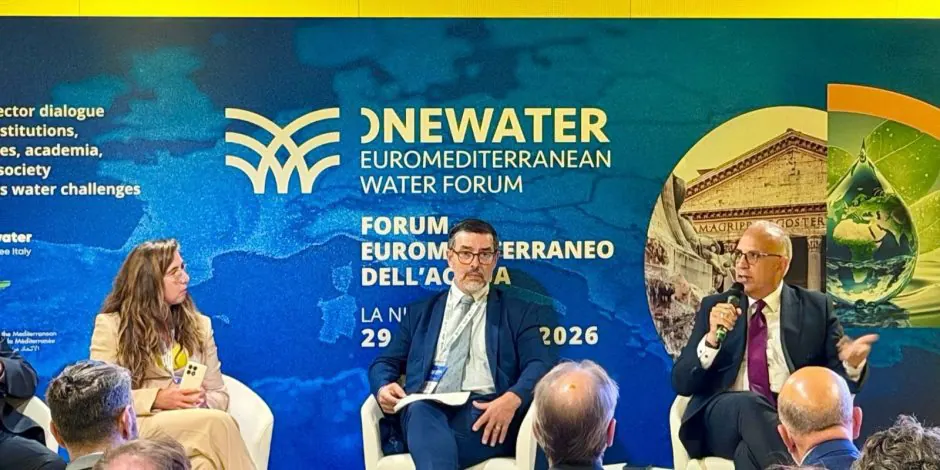
Egyptian Minister of Water Resources and Irrigation, Hani Suwelim, participated in a session on promoting the application of the water-energy-food-ecosystem nexus in the Mediterranean region. The session, organized by the Partnership for Research and Innovation in the Mediterranean Area (PRIMA), discussed ways to transition the concept of interconnection from theoretical frameworks to practical implementation. Minister Suwelim emphasized that the concept of interconnection represents a key approach to achieving sustainable development.
Suwelim highlighted the close relationship between water, energy, food, and ecosystems, noting that dealing with them in an integrated manner allows for greater utilization of available resources. This approach enhances the ability to face common challenges and supports the achievement of sustainable development goals. The Minister also stressed the importance of applying the concept of interconnection at the regional and transboundary levels.
The Minister cited the Nile Basin as an important model for the benefits of integration among basin countries. Through joint action and leveraging diverse available resources, including water, rainfall, agricultural land, solar energy, and wind energy, countries can address common challenges and achieve water, food, and energy security. Suwelim emphasized that the challenges facing Nile Basin countries and the African continent require increased cooperation, integration, and joint action.
Suwelim referenced the African Vision for Water 2063, which provides a framework for African countries to collectively address water, food, and energy challenges. He also noted that the concept of water should not be limited to "blue water" in rivers and lakes but also include "green water" from rainfall stored in soil. This broader perspective on available resources opens up opportunities for development and increased productivity.
The Mediterranean region has vast potential for renewable energy, resources, expertise, and technology, offering significant opportunities for enhanced integration between northern and southern Mediterranean countries. Suwelim discussed the importance of leveraging solar energy for water desalination and food production. He noted the significant progress in renewable energy technologies and the decrease in their costs over the past few years.
The future of using desalinated water in food production is linked to achieving a leap in water productivity through modern agricultural systems, such as hydroponics and aquaponics. Suwelim concluded that the opportunities in Africa and the Mediterranean region are substantial and require enhanced regional cooperation, exchange of expertise, and encouragement of innovation to translate the concept of interconnection into practical projects.
Minister Suwelim's participation in the 2026 Euro-Mediterranean Water Forum highlights Egypt's commitment to promoting sustainable development through integrated water management. The forum provides a platform for countries to share experiences and develop joint solutions to address common challenges. Egypt's efforts to enhance cooperation and integration in the region are crucial for achieving sustainable development goals.
Key points
- The concept of interconnection between water, energy, food, and ecosystems is crucial for achieving sustainable development.
- The Nile Basin serves as an important model for regional integration and cooperation.
- Enhanced regional cooperation and innovation are necessary to leverage available resources and address common challenges.