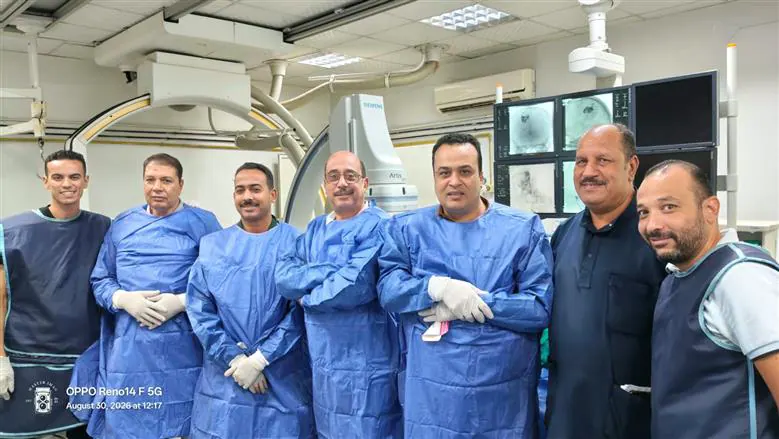
A medical team at Asyut University Hospital's diagnostic and interventional radiology department has successfully treated three complex cases of vascular deformities and bleeding. The cases involved a 18-year-old man with a liver injury, a 22-year-old woman with a uterine arteriovenous fistula, and a 31-year-old man with a kidney injury. The team, led by Dr. Mostafa Hashim, used minimally invasive techniques, including micro-catheter embolization and glue injection, to treat the cases.
The first case involved an 18-year-old man who suffered a liver injury, resulting in a pseudoaneurysm that caused recurrent bleeding and a large hematoma. The medical team successfully closed the pseudoaneurysm using a micro-catheter and glue injection, preserving the liver tissue. The patient was monitored until his condition improved, and he was discharged from the hospital. The team's success in treating this case demonstrates their expertise in handling complex vascular cases.
The second case involved a 22-year-old woman who experienced recurrent uterine bleeding after a dilation and curettage procedure. Diagnostic tests revealed a uterine arteriovenous fistula with multiple dilated blood vessels. The medical team performed a micro-catheter embolization, closing the fistula and injecting glue to seal the dilated blood vessels. The patient's condition improved, and she was discharged from the hospital.
The third case was the most complex, involving a 31-year-old man who suffered a kidney injury when a metal rod penetrated his kidney. Imaging tests revealed a severe injury to the main renal artery, with a large pseudoaneurysm connected to the inferior vena cava. The medical team faced significant challenges in treating this case, as the injury to the main renal artery posed a high risk of artery occlusion, which could have led to kidney damage.
Dr. Mostafa Hashim, the head of the medical team, noted that the team's success in treating these complex cases demonstrates their expertise in vascular interventions. The team's use of minimally invasive techniques, including micro-catheter embolization and glue injection, allowed them to treat the cases without resorting to traditional surgical interventions. This approach reduces the risk of complications and promotes faster recovery.
The department of diagnostic and interventional radiology at Asyut University Hospital has a long history of providing interventional radiology services, dating back to the 1980s. The department's experience and expertise in handling complex vascular cases have been accumulated over several decades, making it one of the leading centers for interventional radiology in Egypt.
The medical team's success in treating these complex cases highlights the importance of minimally invasive techniques in managing vascular diseases. The team's expertise and experience in using these techniques have improved patient outcomes and reduced the risk of complications. The department's commitment to providing high-quality care to patients with complex vascular conditions is evident in its continued use of innovative and effective treatment approaches.
Key points
- The medical team at Asyut University Hospital successfully treated three complex cases of vascular deformities and bleeding using minimally invasive techniques.
- The team's use of micro-catheter embolization and glue injection allowed them to treat the cases without resorting to traditional surgical interventions.
- The department of diagnostic and interventional radiology at Asyut University Hospital has a long history of providing interventional radiology services, dating back to the 1980s.