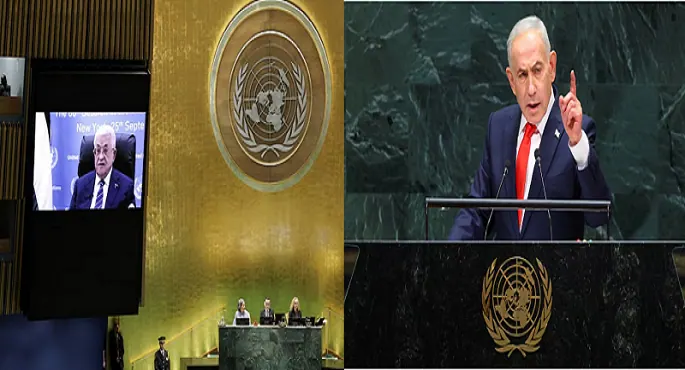
In a recent article published in the Palestinian newspaper "Al-Hayat Al-Jadida", Dr. Bassem Al-Tamimi compared the speeches of Palestinian President Mahmoud Abbas and Israeli Prime Minister Benjamin Netanyahu at the United Nations General Assembly. Al-Tamimi described the two speeches as fundamentally and strategically contradictory. President Abbas delivered a legal and moral argument based on international law, rejecting plans for displacement and the elimination of the Palestinian issue.
The article highlighted that President Abbas's speech was directed towards the international community, emphasizing the need to address the Israeli-Palestinian conflict and its humanitarian consequences. In contrast, Netanyahu's speech was characterized as aggressive and theatrical, focusing on portraying Israel's conflicts in the region as an existential battle against terrorism. Netanyahu denied allegations of genocide and attacked countries that have imposed sanctions on Israeli settlements.
The comparison between the two speeches also revealed differences in their tone and body language. President Abbas's performance was marked by seriousness and determination, reflecting the gravity of the situation. On the other hand, Netanyahu's speech was accompanied by dramatic gestures and visual effects, aiming to project an image of strength and resilience.
The article also discussed the implications of the speeches for the Israeli-Palestinian conflict and the international community's response. The author argued that the Palestinian narrative, as presented by President Abbas, was more cohesive and widely accepted internationally, while Netanyahu's speech was met with skepticism and criticism.
In another article published in the Kuwaiti newspaper "Al-Siyassa", Abdul Nabi Al-Sha'ala, the former Bahraini Minister of Labor and Social Development, questioned whether Iran's policy or rhetoric would change in response to international pressure. Al-Sha'ala argued that Iran's actions, rather than its words, would determine the success of any potential diplomatic efforts.
The article also touched on the issue of Iran's nuclear program and the need for transparency and cooperation with the International Atomic Energy Agency. Al-Sha'ala emphasized that Iran's right to peaceful use of nuclear energy was conditional on its commitment to international obligations and verification.
Furthermore, the article discussed the impact of US-China relations on global politics, with a focus on trade and security issues. The author noted that the two countries had reached a temporary truce, but underlying tensions and competition for influence and technology would continue to shape their relationship.
Key points
- The Israeli-Palestinian conflict and Iran's nuclear program are key issues in the Middle East.
- US-China relations have significant implications for global trade and security.
- Diplomatic efforts and cooperation are essential for addressing pressing global challenges.