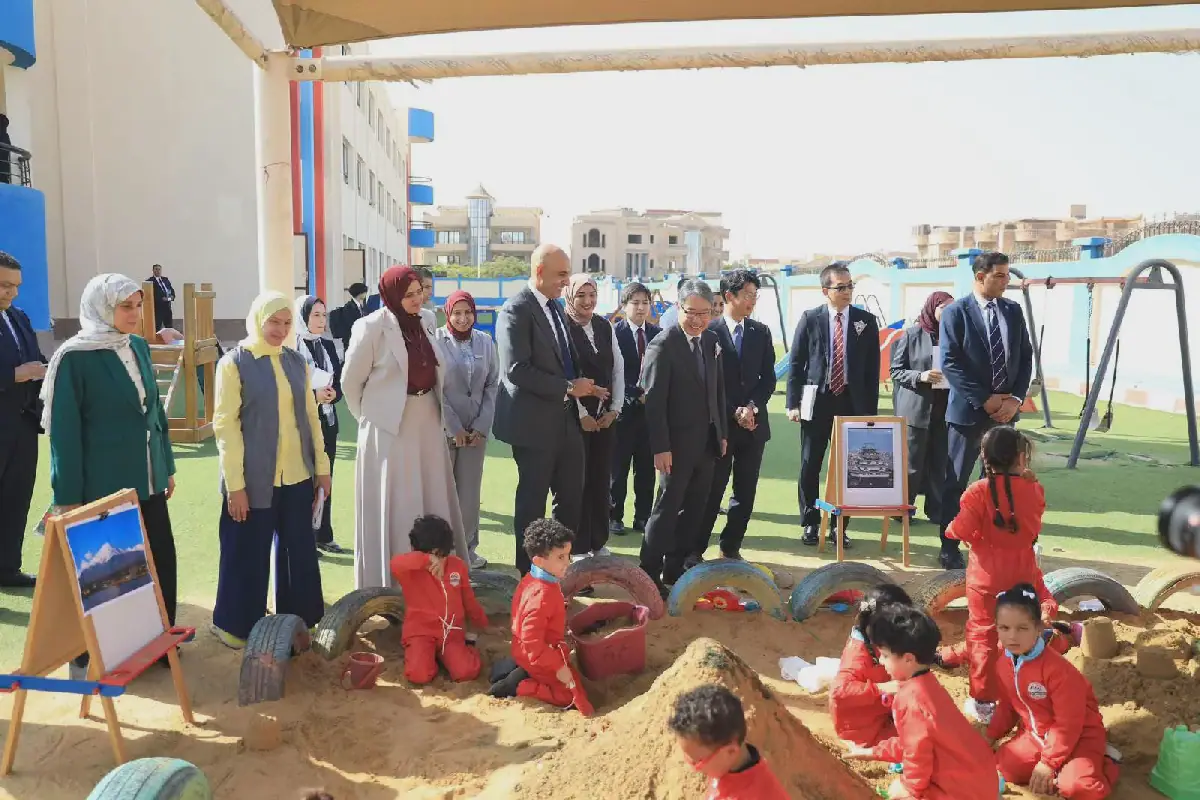
Egypt's Minister of Education and Technical Education, Mohamed Abdel Latif, and a high-level Japanese delegation visited the Egyptian-Japanese School in Obour City to monitor the integration of Japanese language instruction. The programme, introduced in 10 Egyptian-Japanese Schools nationwide, currently enrolls around 400 students. This initiative marks a significant milestone in educational cooperation between Egypt and Japan, which began in 2016.
During the visit, Abdel Latif and the delegation observed a Japanese language class and reviewed teaching methods that utilize songs and pictures for simplified learning. They also watched interactive sessions designed to develop students' dialogue, leadership, and creative skills. The minister highlighted that introducing Japanese as a second language aims to build students' personalities and shape their awareness, prioritizing responsibility, cooperation, discipline, respect, and character development.
The Japanese delegation included Yu Ebisawa, Chief Representative of the Japan International Cooperation Agency (JICA) in Egypt, and Yasuhiro Tsukamoto, Deputy Chief of Mission at the Japanese Embassy in Cairo. Shinya Kurosawa, President of the Japan Foundation, and Ayumi Hashimoto, Director of the Japan Foundation in Cairo, also attended the visit. The delegation expressed their pride in the initiative, noting it is the largest implementation of Japanese language education at this academic level in the Middle East and North Africa.
Kurosawa stated that the Japan Foundation provided the designated textbook, "TANOSHI NI HONGO," and supported teacher training programmes. He emphasized that teaching the Japanese language gives students the opportunity to learn about different cultures, values, and ways of thinking. Tsukamoto commended the enthusiasm of teachers and students during the language classes and expressed hope that the programme would deepen students' understanding of Japanese culture.
In addition to language instruction, the delegation observed an open learning session titled "How do we make a memory book?", where a student led a discussion with peers in a practical application of leadership and teamwork. In another class, fifth-grade students explored ancient Egyptian hieroglyphs alongside Japanese "Kanji" symbols through group work. The tour concluded in the schoolyard, where kindergarten students sang traditional Japanese songs.
Abdel Latif noted that learning Japanese could open future opportunities for students in science, technology, business, and international cooperation, while fostering cultural understanding. The minister's advisor for strategic relations and general supervisor of the Egyptian-Japanese Schools, Nevine Hammouda, also attended the visit. The Egyptian-Japanese educational partnership has proven that education extends beyond knowledge and information to building personalities and shaping awareness.
The introduction of Japanese language instruction in Egyptian-Japanese Schools is expected to strengthen the educational cooperation between Egypt and Japan. With 400 students currently enrolled, the programme aims to prepare youth for academic excellence and community service. The initiative has been hailed as a significant milestone in the partnership between the two countries, which began in 2016 with a shared vision between Egyptian President Abdel Fattah al-Sisi and late Japanese Prime Minister Shinzo Abe.
Key points
- Egyptian-Japanese Schools launch Japanese language instruction for first prep students nationwide
- The programme currently enrolls around 400 students in 10 Egyptian-Japanese Schools
- The initiative marks a significant milestone in educational cooperation between Egypt and Japan, which began in 2016