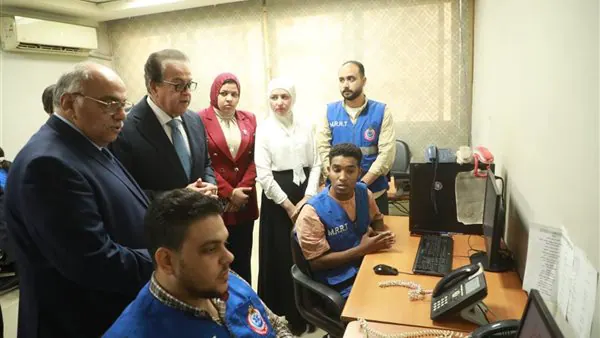
Egyptian Health Minister Khalid Abdel Ghaffar recently visited the 137 Emergency Services Center and the National Project for Emergency Care, "Racayat Masr," to assess the efficiency of services provided to citizens. During the visit, he checked on the latest mechanisms for receiving reports, monitoring critical cases, and coordinating transfers and admissions. The minister stressed that rapid response to citizens' needs is a top priority and that citizens have the right to receive appropriate healthcare services in a timely manner.
The minister reviewed the operations of the 16474 hotline, which is part of the "Every Second Counts" heart initiative and the stroke initiative. He observed the mechanisms for receiving calls, registering cases, and directing them. According to the ministry, a total of 22,736 cases have been registered, including 7,490 catheterization cases, 3,633 stent implantation cases, and 363 pacemaker implantation cases. Additionally, the stroke initiative has recorded 1,371 cases since its launch in April 2024, including 15 cerebral catheterization cases and 1,290 injection cases.
During the visit, the minister was presented with a detailed proposal for the "Command Center" project, which aims to establish a comprehensive system for real-time monitoring of critical cases across the country and tracking available beds. This project is expected to support rapid decision-making, case management, and efficient use of capacity. The minister also inspected the complaint and inquiry room, monitoring the workflow from receiving calls to providing appropriate guidance.
The minister listened to a random call about a poisoning case that was transferred to a doctor within one minute, praising the rapid response and efficient handling. He also reviewed the 137 Emergency Services Center's operations, which has received a total of 999,766 calls, with an immediate response rate of 98.2% and an average of 83,314 cases per month.
In the "Racayat Masr" room, the minister reviewed indicators for monitoring cases and admission requests, with a total of 796,722 registered cases, an average of 66,394 cases per month, and 2,213 cases per day. A total of 225,907 cases were admitted through the central room, with an average of 18,826 cases per month and 628 cases per day. The average waiting time was 14 hours for intensive care and 6 hours for incubators, with a 75% reduction in admission time.
The minister also learned about the connection and coordination mechanisms between the main control room and the ambulance system and the "Racayat Masr" project. According to Dr. Hussam Abdel Ghaffar, the capacity of the system has increased significantly, with 1,403 intensive care beds added, representing a 44.8% increase, 742 incubators added, representing a 23.7% increase, and 603 medium-care beds added, representing a 19.3% increase.
The Egyptian Ministry of Health aims to further reduce waiting times, targeting an average of four hours. The visit reflects the ministry's efforts to improve emergency services and healthcare quality, emphasizing rapid response and efficient case management. The minister's inspection highlights the ongoing efforts to enhance the healthcare system, ensuring timely and effective services for citizens.
Key points
- Egyptian Health Minister Khalid Abdel Ghaffar emphasizes rapid response to citizens' needs.
- The 137 Emergency Services Center has received 999,766 calls with an immediate response rate of 98.2%.
- The ministry aims to reduce waiting times for admissions to an average of four hours.