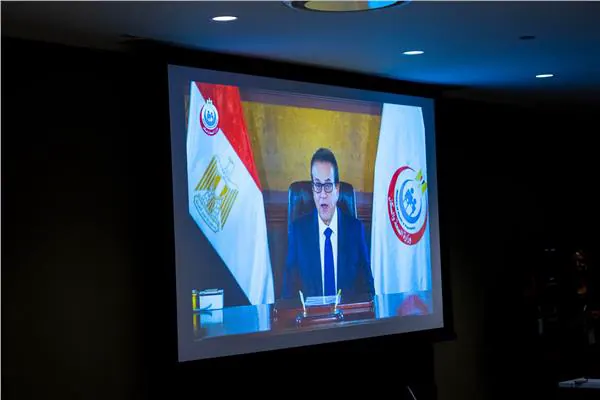
Egyptian Health Minister Dr. Khalid Abdel Ghaffar delivered a recorded opening speech at a high-level dialogue titled "Protective Preparedness: Enhancing Pandemic Preparedness through Resilient Health Systems and Continuity of Essential Health Services." The event was held at the United Nations headquarters in New York on the sidelines of the 81st session of the UN General Assembly. The dialogue was co-hosted by the Egyptian Ministry of Health, the Spanish Ministry of Health, and the International Federation of Red Cross and Red Crescent Societies.
Dr. Abdel Ghaffar emphasized that pandemic preparedness goes beyond responding to crises, but rather begins with building resilient health systems that can ensure continuity of essential services and protect public health in various circumstances. He stressed the importance of sustainable investment in primary healthcare, surveillance, vaccinations, workforce, supply chains, and community systems. The minister highlighted that the COVID-19 pandemic and other global health crises have shown that threats are ongoing, interconnected, and unpredictable.
The Egyptian Health Minister noted that each outbreak tests the capacity of health systems not only to detect and contain the crisis but also to maintain vaccination programs, maternal and child care, treatment of non-communicable diseases, mental health, and palliative care while protecting healthcare workers. He pointed out that pandemic preparedness and the capacity of health systems to withstand crises are two sides of the same responsibility, which is to protect lives before, during, and after crises.
Dr. Abdel Ghaffar emphasized the need to strengthen primary healthcare, surveillance and early detection capabilities, supply chains, infrastructure, and protection of the workforce, as well as community participation and sustainable access to services. He stressed that preparedness should be human-centered and reach the most vulnerable groups, including children, the elderly, people with chronic diseases, people with disabilities, migrants, refugees, and displaced persons.
The minister highlighted the importance of the high-level meeting at the UN on preventing and preparing for pandemics, emphasizing the need to translate lessons learned into concrete actions and sustainable investments. He called for international solidarity and cooperation to enhance health systems and ensure equitable access to pandemic preparedness and response.
Dr. Abdel Ghaffar emphasized that equity should be at the forefront of pandemic preparedness, ensuring that all countries have the capacity for early detection, protection of healthcare workers, maintenance of essential services, and access to medical measures and rapid recovery. He concluded that resilient health systems are built long before a crisis and are tested during it, and that such systems can continue to provide essential care while responding to outbreaks.
The Egyptian Health Minister's speech at the UN dialogue reflected Egypt's commitment to pandemic preparedness and building resilient health systems. The event brought together ministers and officials from several countries, including the UAE, Norway, and Spain, as well as leaders of international organizations and humanitarian institutions.
Key points
- Dr. Khalid Abdel Ghaffar emphasized the importance of pandemic preparedness and resilient health systems at a high-level UN dialogue.
- The Egyptian Health Minister called for sustainable investment in primary healthcare, surveillance, and workforce to enhance pandemic preparedness.
- Dr. Abdel Ghaffar stressed the need for international solidarity and cooperation to build resilient health systems and ensure equitable access to pandemic preparedness and response.