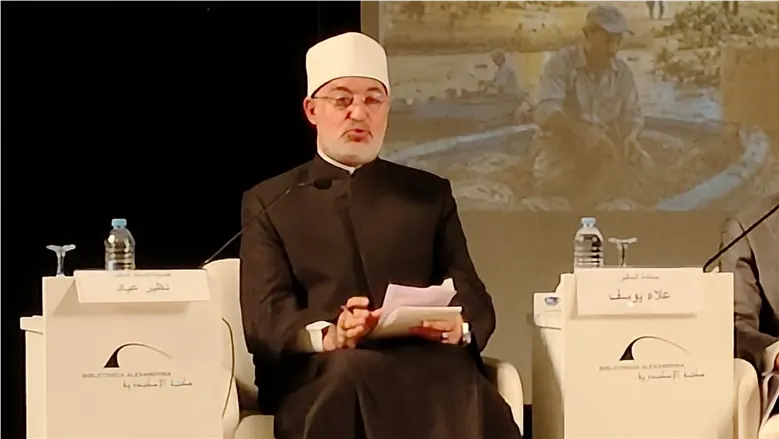
Dr. Nazir Ayyad, the Grand Mufti of Egypt, recently participated in a discussion titled "The discourse of Islamic political currents regarding Egyptian identity." The session was part of a conference on "National Identity: Rooted Roots and a Renewed Vision" held at the Bibliotheca Alexandrina. Ayyad stressed that discussing the issue of Egyptian identity in relation to Islamic political currents requires a comprehensive approach, incorporating religious, media, political, social, and field dimensions.
Ayyad praised the diversity of specialties among the session participants, noting that interdisciplinary studies can provide more accurate readings of issues related to national identity. He emphasized the need for cooperation between concerned institutions while maintaining objectivity and working to correct concepts that may affect understanding identity and belonging. Ayyad highlighted that Egyptian national identity consists of interconnected elements, including homeland, history, language, religion, and civilization.
The Grand Mufti warned about what he termed a "war of misconceptions," stressing the importance of restoring and promoting the Egyptian narrative that clarifies the depth and historical development of Egyptian civilization. He called for a scientific study of ancient Egyptian civilization, avoiding reduction to a specific time frame or narrow context. Ayyad pointed out that there are religious, intellectual, and philosophical aspects that can be addressed through comparative studies.
Ayyad discussed the impact of digital space and modern knowledge sources on national identity. He noted that the uncontrolled use of digital knowledge sources may lead to cultural infiltration, contributing to the spread of misconceptions about issues like extremism and terrorism. Ayyad urged specialized institutions to enhance their role in providing accurate knowledge and helping the public access information from reliable sources.
The Grand Mufti emphasized distinguishing between Islam and the practices of some of its adherents, stressing that judgments about the religion should not be based on the behavior of a few followers. He also highlighted the need to separate religious and national belonging, noting that both can complement each other without one negating the other, while preserving a unifying national identity.
Ayyad pointed out that the transformations brought about by digital space and modern sources of knowledge impose new challenges on scientific, religious, and media institutions. He called for promoting the role of specialized institutions in providing accurate knowledge and helping the public access information from reliable sources.
The conference on national identity aims to explore and discuss various aspects of Egyptian identity, its roots, and its future vision. The discussions and sessions provide a platform for experts and scholars to share their insights and perspectives on this crucial topic, emphasizing its significance for Egypt's present and future.
Key points
- Dr. Nazir Ayyad emphasizes understanding national identity as a diverse accumulation.
- The Grand Mufti warns about the "war of misconceptions" affecting Egyptian identity.
- Ayyad calls for distinguishing between Islam and practices of some adherents.