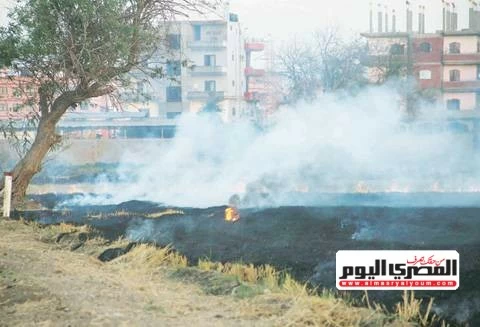
The Egyptian government has launched a comprehensive plan to combat severe air pollution, known as the 'black cloud', during the autumn season. According to Dr. Manal Awad, Minister of Local Development and Environment, the plan involves early detection, rapid intervention, and strict control of pollution sources. The initiative also focuses on public awareness and community participation to mitigate the effects of air pollution.
The early warning system, utilizing satellite imagery, detected 486 instances of crop residue burning in Greater Cairo, the Delta region, and Asyut between September 1 and October 7. This marks a significant decrease of 161 incidents, or 24.8%, compared to the same period in 2025. Furthermore, emissions were monitored at 173 chimneys belonging to 32 facilities in these regions, with 81 cases of excessive emissions identified and addressed.
The government has made significant progress in collecting and utilizing rice straw, a major contributor to air pollution. In the seven Delta governorates where rice is widely cultivated, 1,216,075 tons of straw have been collected, with 53.08% of the harvest processed. These efforts have helped prevent emissions of approximately 16,611 tons. By addressing agricultural waste, the government aims to minimize the impact of the 'black cloud' on air quality.
Joint campaigns have been conducted to inspect vehicle emissions, in collaboration with the General Traffic Administration and the Environmental and Water Police. In the Greater Cairo region, 3,208 vehicles were inspected, with 2,298 passing the test. A further 536 vehicles were re-examined, and 514 passed. Additionally, 514 vehicles underwent the legal settlement process. Regular inspections were also carried out on the public transportation fleet, covering 643 buses.
Dr. Manal Awad emphasized that the Ministry of Local Development and Environment is committed to addressing air pollution through a multi-faceted approach. The government has been working to identify and mitigate pollution sources, while promoting public awareness and community involvement. By implementing these measures, the authorities aim to reduce the severity of the 'black cloud' phenomenon and improve air quality.
The efforts to combat air pollution have involved various stakeholders, including local authorities, law enforcement agencies, and the private sector. By coordinating with different entities, the government has been able to implement a comprehensive strategy to tackle the issue. The results of these efforts are evident in the decrease in crop residue burning incidents and the collection of rice straw.
The government will continue to monitor and address air pollution, with a focus on preventing and mitigating the effects of the 'black cloud'. The Ministry of Local Development and Environment remains committed to implementing measures to improve air quality and protect public health. Key initiatives will focus on enforcing regulations, promoting sustainable practices, and engaging the public in pollution-reduction efforts.
Key points
- The Egyptian government has launched a comprehensive plan to combat severe air pollution during the autumn season.
- The early warning system detected a significant decrease in crop residue burning incidents compared to the same period in 2025.
- The government has made significant progress in collecting and utilizing rice straw, a major contributor to air pollution.