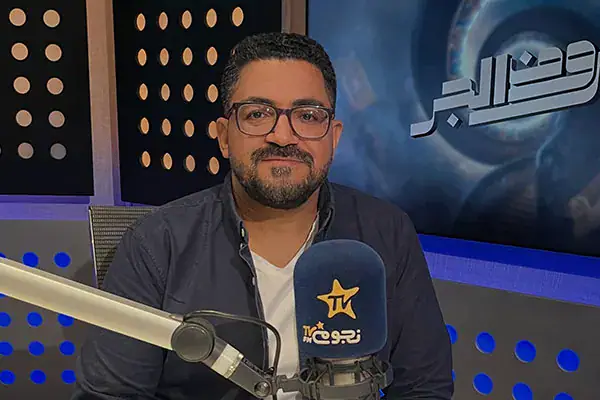
Egyptian film director Ahmed Zakarya recently appeared on the "Hروف الجر" program on Nogoum FM, where he discussed his journey into documentary filmmaking. Zakarya's interest in filmmaking began at a young age, inspired by his father who worked in television production. He started experimenting with his father's camera and later used it during his media studies. His early experiences ultimately led him to work as a reporter for several satellite channels.
Zakarya emphasized the significance of artificial intelligence in the cinematic process, highlighting its ability to overcome challenging production obstacles. He cited the example of director Karim Abdel Wahab, who used AI in the production of the film "آخر رقصة في كيبور". The AI technology enabled the team to achieve difficult shots and overcome production challenges. Zakarya expressed his admiration for the experiment, which he believes will pave the way for a new school of filmmaking that incorporates AI.
Zakarya also discussed the differences between documentary and feature filmmaking, noting that documentary films typically require less equipment. He mentioned the film "طائر النورس" by director خيري بشارة, which tells the story of workers in Sinai and captures their struggles. Zakarya's comments highlight the versatility of documentary filmmaking and its ability to tackle complex social issues.
The conversation also touched on the work of director علي الغزولي, who began his career as a cinematographer for feature films and later transitioned to documentary filmmaking. Zakarya praised الغزولي's work, citing his unique visual style and ability to capture the essence of Sinai and its people. Despite his contributions to Egyptian cinema, Zakarya noted that الغزولي's work is often underappreciated.
Zakarya's comments on AI in cinema reflect a growing trend in the industry, where filmmakers are increasingly turning to technology to overcome production challenges. The use of AI enables filmmakers to achieve complex shots and create more engaging narratives. As the technology continues to evolve, it is likely to play an increasingly important role in shaping the future of Egyptian cinema.
The interview with Zakarya highlights the importance of innovation and experimentation in filmmaking. By embracing new technologies and techniques, Egyptian filmmakers can push the boundaries of storytelling and create more engaging films. Zakarya's comments serve as a testament to the country's thriving film industry, which continues to produce talented filmmakers and innovative films.
The discussion on AI in cinema also raises questions about the role of technology in shaping the creative process. As filmmakers continue to experiment with AI, it is likely that the technology will play a more significant role in determining the aesthetic and narrative of films. Zakarya's comments offer a glimpse into the future of Egyptian cinema, where technology and creativity intersect to produce innovative and engaging films.
Key points
- Egyptian film director Ahmed Zakarya sees AI as a valuable tool in overcoming production obstacles in cinema.