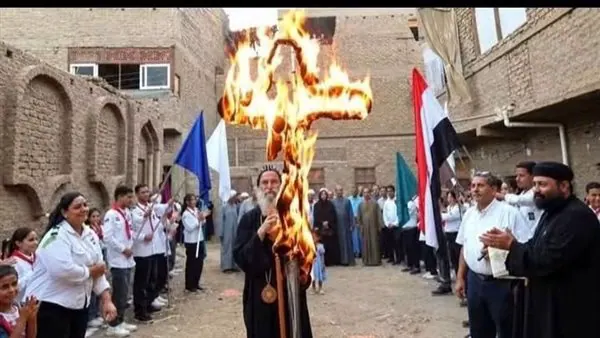
A recent image of Bishop Anba Bimen, head of the Qus and Najada churches, has generated significant attention and debate. The picture shows him holding a cross engulfed in flames during a celebration of the Cross's feast day. This unusual scene has raised questions about the significance of fire in Coptic Christian traditions and whether it implies the actual burning of the cross.
The story behind this tradition dates back to the 4th century and the discovery of the Holy Cross in Jerusalem by Saint Helena, the mother of Emperor Constantine. According to church tradition, the cross was found after a search in the location associated with the crucifixion of Jesus Christ. The fire used to signal the discovery of the cross was a crucial element in spreading the news.
The use of fire to convey the news of the cross's discovery was a practical solution in the ancient world. It involved lighting fires on hilltops, which would then be relayed from one location to another, effectively transmitting the message over long distances. Over time, this practice evolved into a popular tradition associated with the celebration of the Cross's feast day in some Christian communities.
In the context of Coptic Christian celebrations, the fire accompanying the cross symbolizes the light and revelation associated with the discovery of the Holy Cross. However, it is essential to distinguish between liturgical practices and popular customs. Not all churches follow the same traditions during the Cross's feast day celebrations.
The image of Bishop Anba Bimen holding a burning cross has been misunderstood by some as implying the actual burning of the cross. However, this interpretation neglects the historical and cultural context of the tradition. The fire represents a symbolic connection to the past, rather than an act of destruction.
The Cross's feast day is a significant celebration in the Coptic Christian calendar, commemorating the discovery of the Holy Cross. Various regions have developed unique customs and practices to mark this occasion, including the use of fire. These traditions have been passed down through generations and continue to play an essential role in Coptic Christian heritage.
Ultimately, the image of Bishop Anba Bimen with a burning cross serves as a reminder of the rich history and cultural significance of the Cross's feast day in Coptic Christian traditions. Rather than implying destruction, the fire represents a connection to the past and the celebration of a pivotal moment in Christian history.
Key points
- The burning cross is a symbol of the light and revelation associated with the discovery of the Holy Cross.
- The tradition of using fire during the Cross's feast day celebrations dates back to the 4th century.
- The image of Bishop Anba Bimen with a burning cross has sparked controversy and curiosity among Copts.