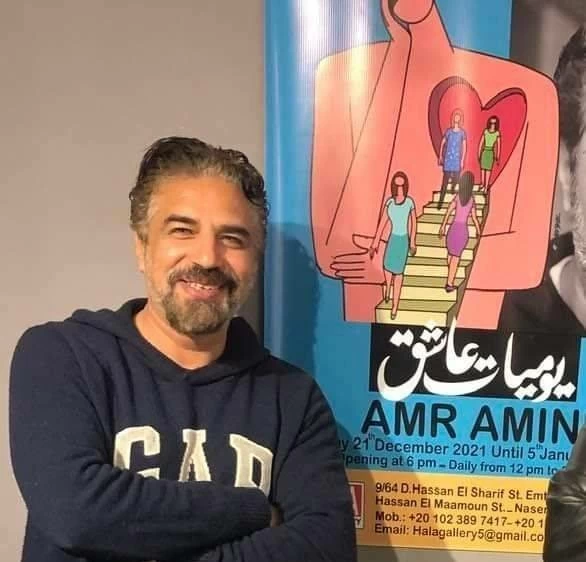
The Cairo Economic Court is set to hear the trial of Egyptian cartoonist Amr Amin on charges of attacking family values and misusing social media. The case dates back to a complaint filed by lawyer Tarek El- Awady, who demanded that authorities take action against Amin for a post and drawing he shared on his personal social media page. Amin was subsequently arrested, and his phone was confiscated before he was interrogated about the content of the complaint.
Amin's arrest and interrogation were conducted after El- Awady's complaint, which led to an investigation into the cartoonist's social media activity. According to Amin's defense team, led by Momen Ezz El-Din, the artist had expressed respect for societal values and had apologized for any misunderstanding caused by his artwork. The defense argued that a case of mistaken identity had occurred due to a similarity in names, leading some to wrongly believe that Amin was the ex-husband of a deceased woman.
Amin's lawyer clarified that the artist had created and published his artwork long before a publishing ban was issued in the case. At the time, Amin had only expressed condolences for the deceased without making any negative comments. The defense team emphasized that their client had not intended to cause offense and had been misunderstood. Amin was released on bail, with his place of residence serving as a guarantee.
The case has sparked attention due to concerns about freedom of expression and artistic license in Egypt. Many have questioned whether Amin's artwork truly constituted an attack on family values or if it was simply a case of misinterpretation. As the trial progresses, it remains to be seen how the court will rule on the matter. Amin's supporters argue that his work is a form of legitimate artistic expression.
Egyptian authorities have been keen to regulate social media and online content in recent years, often citing concerns about national security and public morality. Critics, however, argue that such measures can be used to stifle dissent and creative freedom. Amin's case has raised questions about the limits of artistic expression in Egypt and the extent to which the state can regulate online content.
The trial is also significant in light of Egypt's broader cultural and social dynamics. The country has a rich tradition of satire and caricature, with many artists using their work to comment on politics and social issues. Amin's supporters argue that his work is part of this tradition and that it should be protected under the country's laws and constitution.
As the trial comes to a close, the court will have to weigh the evidence presented and make a decision on Amin's guilt or innocence. The case has sparked a national conversation about artistic freedom, and many are watching with bated breath to see how it will unfold. A decision is expected soon, and it remains to be seen what implications the verdict will have for Egyptian artists and the broader cultural landscape.
Key points
- The trial of Amr Amin raises questions about the limits of artistic expression in Egypt and the regulation of online content.
- Amin's defense team argues that the artist was misunderstood and had not intended to cause offense with his artwork.
- The case has sparked a national conversation about artistic freedom and its implications for Egyptian artists.