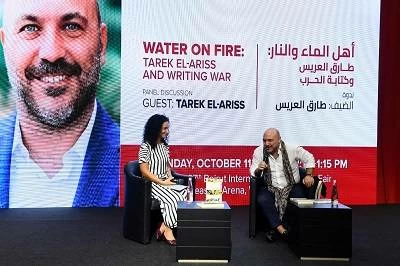
The Beirut International Arab Book Fair recently hosted a literary and cultural symposium to discuss the book "Ahl Al-Ma' Wa Al-Nar" by Egyptian writer and researcher Dr. Tarek El-Ariss. The event was moderated by journalist Sara Tello and attended by prominent figures, including the head of the Arab Cultural Club, Salwa Al-Sneuwara Ba'assiri, as well as numerous writers, intellectuals, and those interested in literary affairs.
The discussion began with Tello reading from the book's contents, highlighting its exploration of the journey of migration that begins in war-torn Beirut and extends to snow-covered cities in the eastern United States. The book portrays a human experience shaped by spiritual resilience, mixed with sarcasm and courage, as the protagonist navigates loss and transformation.
Dr. El-Ariss delved into the controversial relationship between water and fire in his book, explaining how the idea originated from his desire to give a lecture about Beirut. However, his experience led him to explore its connection to the sea and the contradictory connotations it holds. He described Beirut as a city open to the sea, yet enclosed by it, with a modern coastline that has strayed from its natural and traditional romantic image.
El-Ariss pointed out the paradox of Beirut's residents turning their backs on the sea, despite it being their sole outlet during wartime. He also discussed the illusion of freedom and open horizons, noting that water in the book symbolizes longing and necessity, but is also associated with pain and the ache of absence. These connotations intersect with Beirut's experience, which has been sandwiched between the fire of war and the waters of the sea.
The author discussed his use of a psychoanalytic approach based on Freudian analysis, revealing that he grew up in a family influenced by Freud. Initially, he planned to start the book with a chapter on "people of the sea," but conversations with those close to him led him to introduce a premise that explores the deep motivations behind writing the book. This structure allowed the journey to begin with questions about writing and its motivations, concluding with a psychoanalyst.
The symposium shed light on "Ahl Al-Ma' Wa Al-Nar" as a work that goes beyond narrating a migration experience, instead exploring the human relationship with place, memory, and loss. The discussion showed how geography intertwines with psychological experience in shaping the meaning of homeland and exile. The event offered a fresh perspective on the book, highlighting its depth and complexity.
The discussion at the Beirut International Arab Book Fair has sparked interest in Dr. Tarek El-Ariss's work, offering readers a deeper understanding of his literary endeavors. The event demonstrated the significance of such cultural gatherings in fostering a greater appreciation for Arabic literature and encouraging dialogue among intellectuals and readers.
Key points
- Dr. Tarek El-Ariss's book "Ahl Al-Ma' Wa Al-Nar" explores themes of migration, human experience, and the relationship between geography and psychological experience.