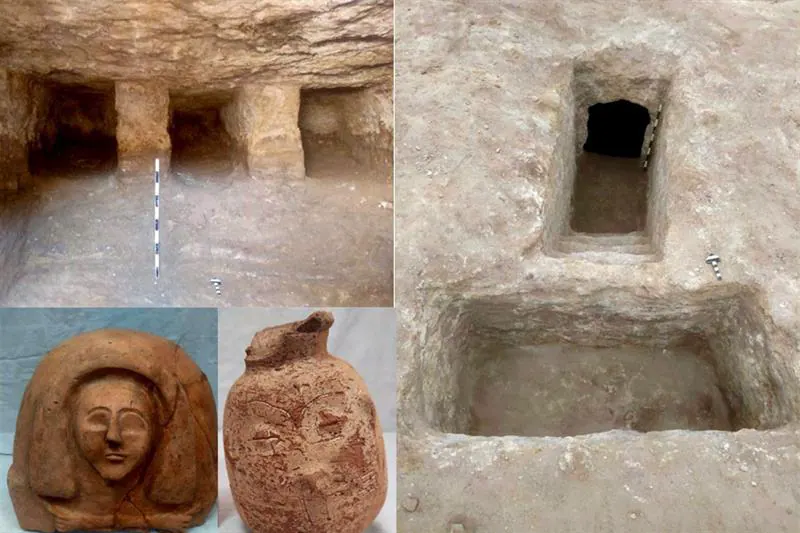
A recent archaeological mission in Tell el-Yahoudieh, Qalioubiya, Egypt, has led to the discovery of multiple rock-cut tombs and a Roman camp. According to a statement released by the Egyptian Council of Ministers, the tombs exhibit various architectural styles, adding a new dimension to the site's history. This finding confirms that the area was occupied during different historical periods, reflecting its strategic importance and role over the centuries.
The archaeological mission, which focused on the Tell el-Yahoudieh site, uncovered several rock-cut tombs with distinct architectural features. The tombs have been dated to the end of the New Kingdom period and continued to be used until the Late Period. The discovery highlights the significance of the site for understanding funerary practices and their evolution in the eastern Nile Delta region.
The tombs discovered in Tell el-Yahoudieh belong to two primary architectural types. The first type features an entrance preceded by a staircase leading to a chamber with funerary niches used for inhumations. The second type consists of a rectangular shaft providing access to two burial chambers. These architectural styles are characteristic of the Qalyoubia region and the eastern Nile Delta, given the area's clay soil.
Tell el-Yahoudieh is primarily associated with the Hyksos period, a time when a Semitic population from the Near East ruled part of Egypt during the Second Intermediate Period. The site also features a vast camp dating back to this period, which continued to be utilized during the Greek and Roman eras.
The discovery of the Roman camp, situated in the superficial layer of the site, above the rock-cut tombs, further emphasizes the site's historical significance. The camp's presence indicates that the area remained occupied and strategically important throughout various historical periods.
The Egyptian Council of Ministers has highlighted the importance of this discovery, which sheds new light on the history of Tell el-Yahoudieh and its role in the region. The site's continued occupation and utilization over the centuries underscore its strategic significance and the evolution of funerary practices in the area.
The discovery of these rock-cut tombs and the Roman camp in Tell el-Yahoudieh contributes significantly to our understanding of ancient Egyptian history and funerary practices. The site's excavation has provided valuable insights into the lives of the people who lived and died in the region, offering a fascinating glimpse into Egypt's rich cultural heritage.
Key points
- The discovery of rock-cut tombs and a Roman camp in Tell el-Yahoudieh, Qalioubiya, Egypt, highlights the site's strategic importance and occupation throughout various historical periods.
- The tombs, dated to the end of the New Kingdom period and used until the Late Period, showcase diverse architectural styles characteristic of the Qalyoubia region and eastern Nile Delta.
- The excavation of Tell el-Yahoudieh has provided significant insights into ancient Egyptian funerary practices and their evolution over time.