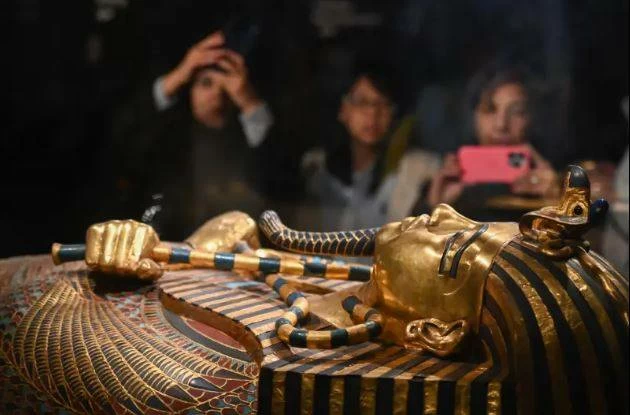
A team of archaeologists has made a groundbreaking claim that they are on the verge of discovering the long-lost tomb of Queen Nefertiti, the "Great Royal Wife" of Pharaoh Akhenaten, who has been missing for over 3,300 years. The team, led by British Egyptologist Nicholas Reeves, believes that Nefertiti's tomb may be hidden behind the walls of Tutankhamun's burial chamber in the Valley of the Kings. This claim has sparked widespread excitement and curiosity among archaeologists and historians.
The search for Nefertiti's tomb has been ongoing for decades, with Reeves being a key figure in the quest. In 2015, he proposed a theory that Nefertiti's tomb could be hidden in plain sight, reused for the burial of her son, Tutankhamun. His hypothesis was based on unusual features in the design and artwork of Tutankhamun's tomb. While subsequent studies have not yet yielded conclusive evidence, a recent study published in the Occasional Papers series of the Royal Tombs of Amarna project has reignited hopes of uncovering the queen's final resting place.
The recent study suggests that there may be a series of hidden rooms behind the plastered walls of Tutankhamun's tomb. Reeves and his team have discovered new lines and cracks in the northern wall of the burial chamber, which they believe could be indicative of a hidden chamber. The team has also noted hasty alterations to the room's artwork, which may be concealing a secret. According to Reeves, the layout of Tutankhamun's tomb does not conform to the architectural norms of royal or individual tombs, but rather follows the same plan as the tombs of 18th dynasty queens.
The search for Nefertiti's tomb has been driven by the mystery surrounding her disappearance and the lack of knowledge about her final resting place. The queen's half-statue, discovered in 1912, is one of the most iconic and enigmatic images of ancient Egypt. Despite her fame, little is known about her life or death. The discovery of her tomb would be a major archaeological breakthrough, providing valuable insights into the life and reign of one of ancient Egypt's most fascinating figures.
Dr. Mamdouh El-Damaty, former Egyptian Minister of Antiquities and archaeologist at Ain Shams University in Cairo, has expressed his excitement about the prospect of discovering Nefertiti's tomb. If confirmed, the find would be the most significant archaeological discovery in the Valley of the Kings since the discovery of Tutankhamun's tomb in 1922. El-Damaty believes that the discovery would be a game-changer in the field of Egyptology, shedding new light on the history of ancient Egypt.
This is not the first time that archaeologists have claimed to be close to discovering Nefertiti's tomb. In 2022, Egyptologist Dr. Zahi Hawass announced that he had found the mummified remains of Nefertiti among a group of relocated mummies. However, his claim has not been confirmed, and the search for the queen's tomb continues. The current study has generated significant interest and anticipation, with many experts eagerly awaiting the outcome of the excavation.
The discovery of Nefertiti's tomb would be a major archaeological achievement, providing a unique opportunity to learn more about the life and reign of one of ancient Egypt's most enigmatic figures. As the search continues, experts and enthusiasts alike are holding their breath, hoping that the mystery of Nefertiti's disappearance will finally be solved.
Key points
- Archaeologists claim to be nearing the discovery of Nefertiti's lost tomb, hidden behind the walls of Tutankhamun's burial chamber.