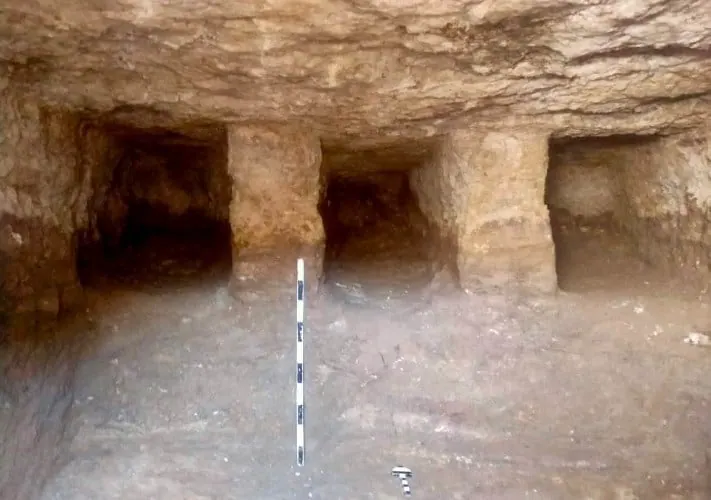
A recent archaeological excavation in Qalyubia, Egypt, led by the Egyptian archaeological mission, has uncovered several rock-cut tombs in the Tel al-Yahudiya archaeological site. These tombs belong to various architectural styles and date back to different periods. The discovery was made during the continuation of excavation works in the area. According to Dr. Hisham El-Lithi, Secretary-General of the Supreme Council of Antiquities, this discovery represents a significant addition to the history of Tel al-Yahudiya.
The tombs discovered are of great importance due to their diverse architectural styles and rarity in the Delta region. The Delta region's clay soil nature makes the discovery of rock-cut tombs particularly significant for understanding burial patterns and their evolution over time. The archaeological evidence suggests that these tombs date back to the late New Kingdom period and were used until the Late Period. This reflects the continuation of funerary activity in the area over successive historical periods.
The excavation works and discovery of archaeological artifacts in the tombs have helped determine their chronological framework. Dr. El-Lithi pointed out that the continuation of the discovery of the remains of the Roman camp in the surface layers above the rock-cut tombs adds a new dimension to the site's history. It confirms the continued use of Tel al-Yahudiya during different historical periods, reflecting its strategic importance and status over time.
Dr. Ayman Ashmawi, consultant to the Secretary-General of the Supreme Council of Antiquities, stated that the discovered tombs belong to two main architectural styles. The first style features tombs with a staircase leading to a hall with openings used for burial. The second style consists of a rectangular well leading to two burial chambers. These styles are unique to the Qalyubia region and the eastern Delta.
The discovered tombs and artifacts have provided valuable insights into the history of the region. Anwar Abdel Samad, director-general of the Qalyubia Antiquities Region and head of the mission, mentioned that the team found several portable antiquities accompanying the tombs. These artifacts helped date the tombs and determine the periods during which they were used.
The archaeological mission has continued its work to uncover the remains of the Roman camp in the surface layers of the site. The discovery of these tombs and the Roman camp highlights the significance of Tel al-Yahudiya throughout history. The site was primarily associated with the Hyksos era, featuring a large camp dating back to that period.
The recent discoveries in Qalyubia underscore the rich history and cultural significance of the region. The Egyptian archaeological mission's findings have shed new light on the evolution of burial practices and the historical importance of Tel al-Yahudiya. Further excavation and research are expected to provide more insights into the region's history and its role in ancient Egypt.
Key points
- The discovery of rock-cut tombs in Qalyubia provides new insights into ancient Egyptian burial practices.
- The tombs date back to the late New Kingdom period and were used until the Late Period.
- The discovery highlights the strategic importance and cultural significance of Tel al-Yahudiya throughout history.