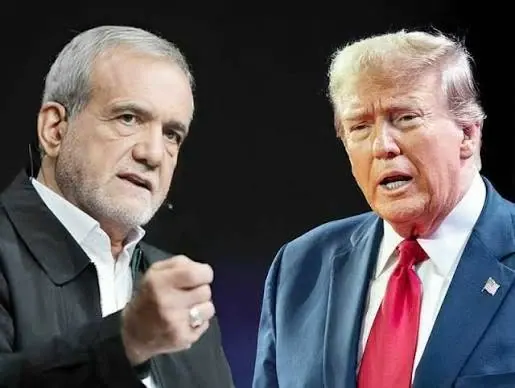
In a significant development in the US-Iranian crisis, US President Donald Trump announced on Tuesday that high-ranking officials from his administration held a three-hour meeting with an Iranian delegation, describing the talks as 'very good'. This meeting, facilitated by Egyptian and Omani mediation, marks a new level of diplomacy between Washington and Tehran, coinciding with the United Nations General Assembly in New York. According to Axios, Trump stated that the meeting was a positive step.
The talks are seen as a breakthrough in US-Iranian relations, with the two nations having not engaged in direct negotiations since the Iranian Revolution in 1979. The meeting was facilitated by several countries, including Egypt and Oman, which have been working to mediate between the US and Iran. Egyptian President Abdel Fattah el-Sisi and Iranian President Masoud Pezeshkian met on the sidelines of the BRICS summit in India, further highlighting the diplomatic efforts.
Dr. Mohamed Majed El-Zayat, a strategic expert and academic advisor at the Egyptian Center for Thought and Political Studies, emphasized that the direct talks between the US and Iran represent an unprecedented development in their relations. He noted that Iran had previously avoided direct meetings with the US, instead relying on mediators in countries such as Oman, Pakistan, and Switzerland.
El-Zayat highlighted the significant role of Egyptian diplomacy in facilitating the talks, citing recent visits by CIA Director to Egypt and contacts between Egyptian Foreign Minister and Iranian officials. These efforts, combined with Omani mediation, created an environment conducive to direct negotiations between the US and Iran.
The strategic expert noted that the US sanctions on Iran have had severe economic and social impacts, but have not led to the collapse of the Iranian regime. In response, Iran has taken measures to counter these pressures, including the formation of the Basij resistance force, comprising men and women, to secure the country's internal front.
El-Zayat also discussed the situation in the Strait of Hormuz, a critical waterway for oil exports, noting that only a few oil tankers have passed through the strait in recent days. He suggested that the US plan to restore maritime trade and navigation has not yet achieved its objectives, despite the pressure on Iran.
The expert concluded that both the US and Iran may have reached a point where they see negotiation as a means to achieve some gains. However, the outcome of the talks and their impact on the complex issues between the two nations remain uncertain, with the stance of hardline factions within Iran being a crucial factor in determining the future of US-Iranian relations.
Key points
- The US and Iran held a three-hour meeting facilitated by Egyptian and Omani mediation.