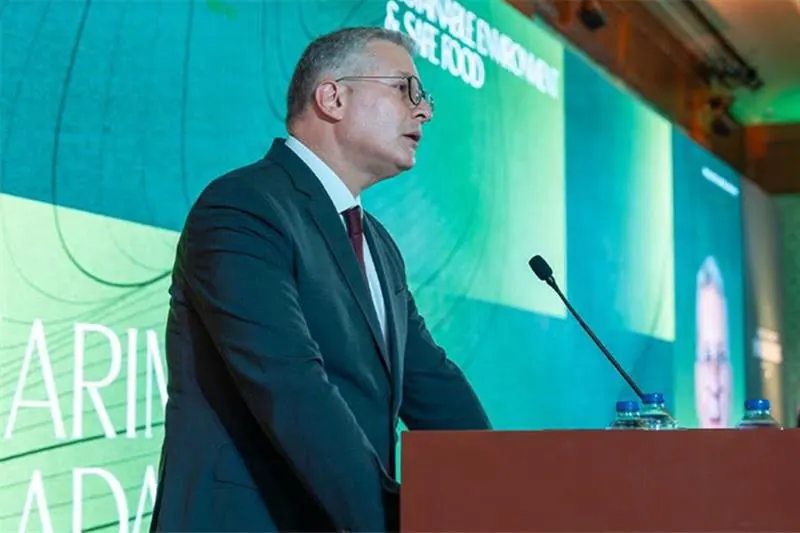
Egypt holds the world's third-largest phosphate rock reserves, with geological reserves estimated at 3.1 billion tons. This provides a strong foundation for expanding phosphate fertilizer production in the near future, according to Minister of Petroleum and Mineral Resources Karim Badawi. The country's annual urea production capacity stands at around 6.5 million tons, making Egypt one of the largest producers in the Arab world.
Egypt's ammonia production capacity exceeds 5 million tons annually. The minister also stated that Egypt has one of the region's most diversified and competitive fertilizer industries, particularly in nitrogen fertilizers. This is supported by abundant phosphate reserves and significant production capacity. The fertilizer industry is strategically important as it sits at the intersection of the energy, agriculture, and industrial sectors, serving as a cornerstone of global food security.
With domestic urea consumption totalling approximately 2.9 million tons a year, Egypt has a substantial export surplus. This surplus is shipped primarily to markets in Europe, Africa, and Asia, according to Badawi. Deep Market Insights values Egypt's agricultural inputs market, including fertilizers, pesticides, seeds, and plant growth regulators, at $5.3 billion in 2025. The market is projected to reach around $7.7 billion by 2034, growing at a CAGR of 4.15 percent from 2026 to 2034.
Egypt accounted for 0.92 percent of the global agricultural inputs market in 2025 and is identified as the fastest-growing market in the Middle East and Africa. The market is anticipated to reach $9.8 billion by 2034. The government is working to raise the mining sector's contribution to gross domestic product from around one percent currently to six percent over the coming years. This plan includes overhauling the mining sector's regulatory framework.
The Egyptian Mineral Resources Authority will be transformed into an economic entity under the name Mineral Resources and Mining Industries Authority. This is part of broader efforts to unlock the sector's economic potential. Minister of Industry Khaled Hashem said the fertilizer industry plays a pivotal role in Egypt's strategy to expand agricultural production through national mega-projects aimed at strengthening food security.
These projects include the New Delta Project and the Mostaqbal Misr (Future of Egypt) Sustainable Development Project. Fertilizers and agricultural nutrients are essential inputs for maximizing the productivity of reclaimed land, increasing crop yields, and supporting sustainable agricultural development. Stronger integration between the fertilizer industry, agriculture, and food manufacturing would create greater value for the national economy.
Industrial development remains a key pillar of Egypt's sustainable economic growth strategy. The Ministry of Industry is implementing a comprehensive plan to increase industrial exports to $100 billion by 2030. The strategy focuses on attracting foreign investment linked to technology transfer, deepening local manufacturing, and integrating Egypt more closely into global production and value chains.
Key points
- Egypt holds the world's third-largest phosphate rock reserves, with geological reserves estimated at 3.1 billion tons.
- The country's annual urea production capacity stands at around 6.5 million tons.
- Egypt aims to raise the mining sector's contribution to gross domestic product from around one percent currently to six percent over the coming years.