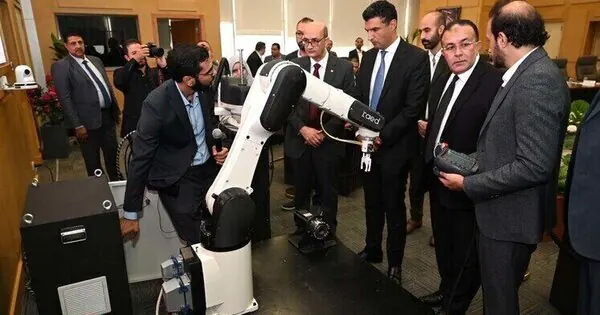
Egypt has unveiled its first homegrown industrial robot, developed by local engineers using domestic technology. The robotic arm, which contains around 80% locally produced components, is being deployed on a packaging line. Industry Minister Khaled Hashem attended the launch ceremony, highlighting the importance of localizing machinery and manufacturing lines as part of Egypt's national industrial strategy.
The robot is being integrated into packaging equipment operated by Egyptian manufacturer QB and is designed for industrial packaging and automation on production lines. According to the Ministry of Trade and Industry, the developers aim to increase the percentage of locally produced components to 90% once motor production is localized. This move is expected to reflect Egypt's ability to develop technology and integrate into global supply chains.
The Ministry of Trade and Industry will monitor the robot's performance in industrial operations to assess its effectiveness and encourage wider adoption by Egyptian factories. Egypt is not the only African country developing local expertise in industrial robotics. Tunisia's TIRA Robots has developed robotic arms for integration into production lines, while other local engineering companies design automated machinery and integrate industrial robots produced by global manufacturers.
Industrial automation is well established in South Africa and Morocco, particularly in the automotive sector. Local companies integrate foreign-made robots into production lines. Morocco-based MTS Robotics develops automated systems for welding, assembly, handling, and packaging. These developments demonstrate the growing interest in industrial automation across Africa.
Egypt has also seen locally developed robots outside the industrial sector. A team from Tanta University won the national RoboDam 2026 competition with an autonomous robot designed for cleaning operations. The university said the system could be manufactured locally at a significantly lower cost than imported alternatives.
The launch of Egypt's homegrown industrial robot is a significant milestone in the country's efforts to develop its manufacturing sector. The robot's deployment is expected to improve efficiency and productivity in the packaging industry. The Ministry of Trade and Industry will continue to monitor the robot's performance and encourage its adoption by other Egyptian factories.
The development of industrial robots in Egypt and other African countries is expected to have a positive impact on the region's manufacturing sector. It will enable local companies to improve efficiency, reduce costs, and increase competitiveness in the global market. The growth of industrial automation in Africa is likely to continue, driven by the need for increased productivity and efficiency.
Key points
- Egypt has launched its first homegrown industrial robot, developed by local engineers using domestic technology.
- The robot's deployment is expected to improve efficiency and productivity in the packaging industry.
- Egypt is not the only African country developing local expertise in industrial robotics, with Tunisia, South Africa, and Morocco also making significant progress in this field.