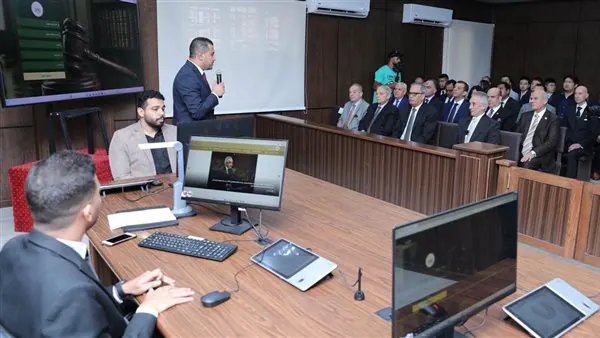
Egypt is set to implement new remote trial procedures in its criminal law starting October 1. The new law, which was approved by the House of Representatives and ratified by President Abdel Fattah el-Sisi, aims to modernize the country's judicial system. The law includes a dedicated chapter on remote trials, outlining the procedures and rules for conducting trials via modern communication technologies. This development is expected to increase efficiency and reduce the need for physical appearances in court.
The new law allows for remote investigations and trials using audio and visual communication technologies. According to Article 530 of the law, these procedures will be conducted in a way that maintains the secrecy of investigations, the presence and publicity of trials, and the right to a fair trial. The law also permits the use of remote trials for defendants, witnesses, and experts, while ensuring that the rights of all parties are protected.
The law grants investigative bodies the authority to conduct remote trials, allowing them to take necessary measures to ensure the smooth conduct of trials. Article 531 of the law states that investigative bodies can decide to hold remote trials for defendants, witnesses, and experts. Additionally, the law permits the use of remote trials for children, with the option to exempt them from physical appearances in court.
The law also outlines the procedures for notifying parties of remote trials. According to Article 533, parties must be informed of the date, time, and location of remote trials. The location must be equipped with the necessary technology to facilitate remote trials. Furthermore, the law requires that all remote trial procedures be recorded and preserved.
Defendants have the right to object to remote trials. Article 535 of the law states that defendants can object to remote trials at the first hearing, and the court must rule on the objection. The law also ensures that defendants are treated fairly and have the right to be represented by their lawyers during remote trials.
The government is responsible for providing the necessary infrastructure for remote trials. Article 537 of the law requires the Ministry of Justice, in collaboration with other relevant ministries and agencies, to establish the necessary facilities and equipment for remote trials. This includes equipping courtrooms and prisons with the necessary technology.
The implementation of remote trial procedures is expected to improve the efficiency of Egypt's judicial system. The new law aims to reduce the backlog of cases and increase access to justice for citizens. With the introduction of remote trials, Egypt's judicial system is taking a significant step towards modernization and digitalization.
Key points
- The new law introduces remote trial procedures in Egypt's criminal law, allowing for more efficient and modern judicial proceedings.
- The law permits remote trials for defendants, witnesses, and experts, while ensuring that the rights of all parties are protected.
- The government is responsible for providing the necessary infrastructure for remote trials, including equipping courtrooms and prisons with the necessary technology.