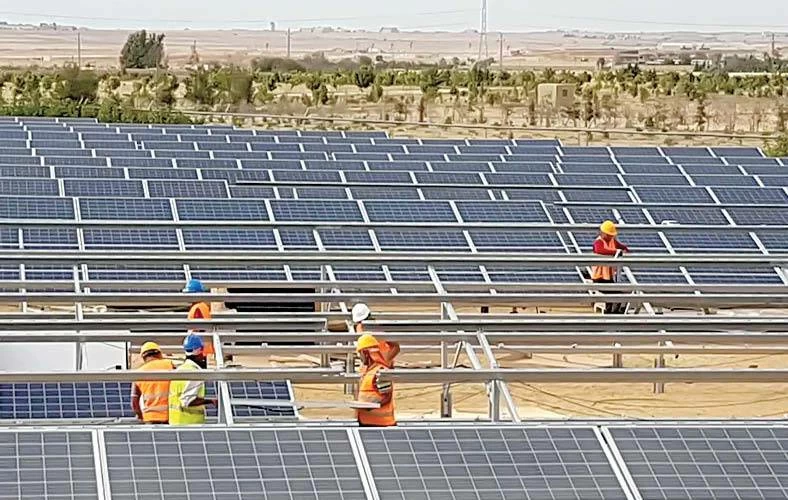
The Egyptian government has released a report highlighting the growth of solar energy in developing economies. The report, issued by the Information and Decision Support Center, notes that solar energy has become a key driver of investment, manufacturing, and job creation in these countries. With the global demand for electricity on the rise, solar energy has emerged as a vital source of new power capacity.
According to the report, Asia is leading the global expansion of solar energy, with China and India at the forefront. China's solar energy sector has experienced significant growth, making it the largest global market in terms of installed capacity and annual additions. In 2025, solar energy accounted for over 10% of China's electricity generation, with expectations to exceed 20% by 2030.
Africa is also witnessing a significant transformation in its solar energy market, leveraging its abundant solar resources. The continent's installed solar capacity has grown from approximately 3 gigawatts in 2016 to around 22.2 gigawatts in 2025. South Africa, Nigeria, Egypt, and Algeria have emerged as key markets, with Egypt adding around 500 megawatts of new capacity in 2025.
The report highlights three primary drivers of solar energy expansion in Africa: decreasing technology costs, increasing demand for electricity, and the need to create jobs and stimulate local economies. The International Renewable Energy Agency notes that the solar energy sector in South Africa created around 33,800 jobs in 2024, with similar trends observed in Egypt.
Egypt is not only expanding its solar energy production but also investing in local manufacturing. Several projects are underway to establish solar panel manufacturing facilities, including a Chinese company's plan to build a 2-gigawatt factory. These initiatives are expected to create hundreds of jobs and contribute to the country's economic growth.
The growth of solar energy in Egypt and Africa is driven by a combination of factors, including declining technology costs, increasing electricity demand, and the need for sustainable energy solutions. As the sector continues to evolve, it is likely to play an increasingly important role in the region's economic development and energy security.
The Egyptian government and international organizations are working together to support the development of the solar energy sector. Initiatives such as the "Mission 300" program aim to provide electricity to millions of people in Africa by 2030, with a focus on off-grid and decentralized energy solutions.
Key points
- Egypt's solar energy sector is growing rapidly, driven by decreasing technology costs and increasing demand for electricity.
- The country is investing in local manufacturing, with several projects underway to establish solar panel manufacturing facilities.
- Solar energy is becoming an increasingly important contributor to Egypt's energy mix, with a focus on sustainable energy solutions and job creation.