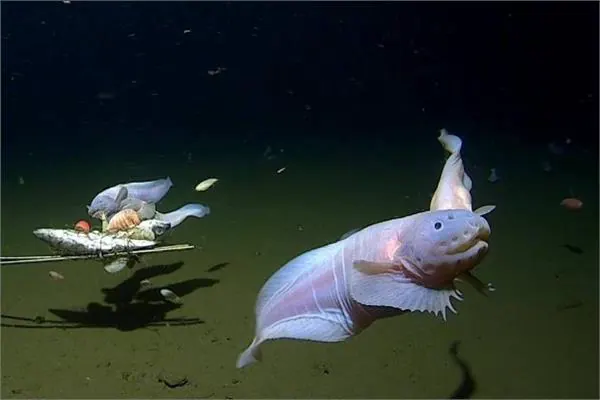
In a groundbreaking scientific achievement, researchers have successfully recorded a new global record for the deepest seafloor catch, surpassing thousands of meters underwater to collect live samples of rare deep-sea creatures. According to recent news reports, a team of scientists managed to catch two fish belonging to the "Pseudoliparis" species using a specially designed and innovative trap capable of withstanding the harsh conditions of the deep sea.
The successful catch took place at an astonishing depth of 8022 meters, setting a new official record for the deepest seafloor catch in the world. The caught specimens belong to the snailfish family, characterized by their remarkable ability to adapt to extreme pressure and darkness at the bottom of the oceans. Although scientists have previously managed to monitor and film these fish on video at depths exceeding 8000 meters, this marks the first time they have been caught alive for study.
The Pseudoliparis species is known for its unique physiological features that enable it to survive in the deep-sea environment. These fish have large eyes, weak muscles, and a slow metabolism, which allows them to conserve energy in the food-scarce deep-sea ecosystem. The discovery of this species at such extreme depths provides valuable insights into the evolution of life in the deep sea.
The research team employed advanced technology and equipment to reach and sample the deep-sea environment. The specially designed trap used for the catch was equipped with high-definition cameras and sensors to monitor the surroundings and ensure the safe collection of the specimens. The successful deployment of this equipment marks a significant milestone in the field of deep-sea exploration.
The discovery of the Pseudoliparis species at 8022 meters depth has significant implications for our understanding of the diversity of life on Earth. The deep sea is a vast and largely unexplored environment, and discoveries like this one highlight the importance of continued exploration and research into the natural world. Further study of this species and its habitat will provide scientists with a better understanding of the complex ecosystems that exist in the deep sea.
The research team's achievement is a testament to the advancements in deep-sea exploration and the importance of continued investment in scientific research. The discovery of new species and ecosystems in the deep sea has the potential to lead to breakthroughs in fields such as medicine, biotechnology, and our understanding of the Earth's ecosystems. As scientists continue to explore the deep sea, they are likely to uncover even more remarkable discoveries.
The successful catch of the Pseudoliparis species at 8022 meters depth is a remarkable achievement that showcases the ingenuity and determination of scientists. The discovery of this species provides a unique opportunity for scientists to study the biology and ecology of deep-sea creatures, and it is likely to inspire further research into the mysteries of the deep sea.
Key points
- Scientists have set a new record for the deepest seafloor catch, collecting live samples of the Pseudoliparis species at 8022 meters depth.