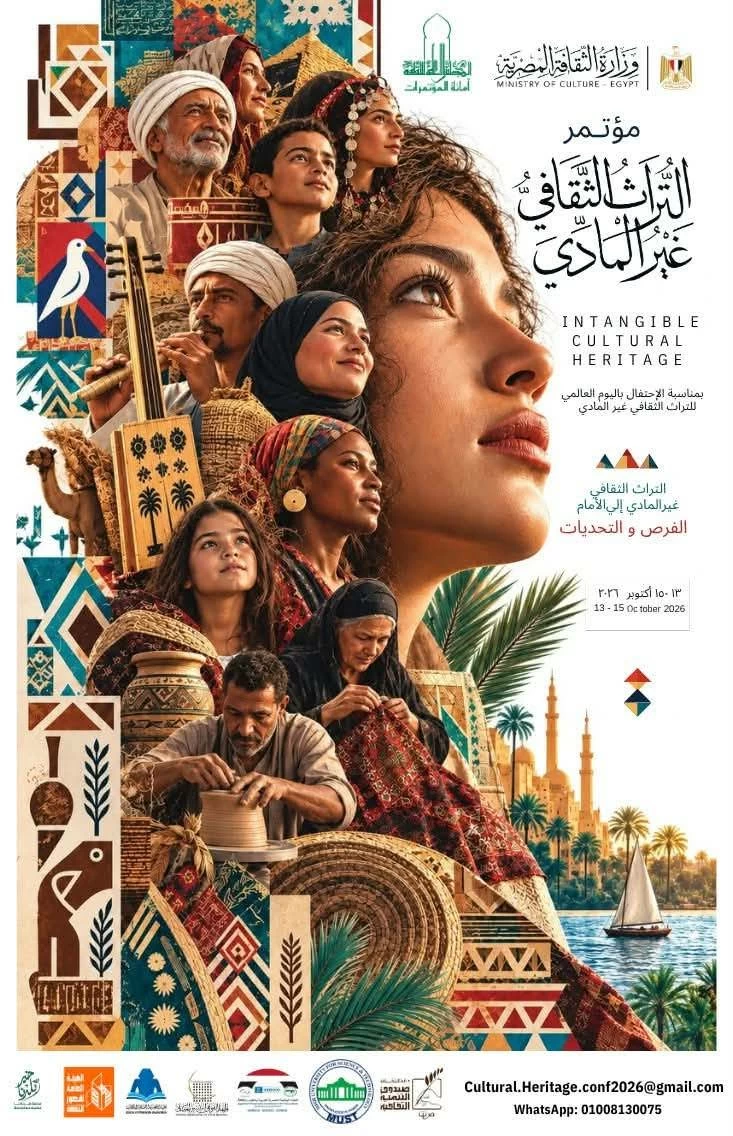
The Supreme Council for Culture in Egypt has announced that it will be hosting a conference titled "Intangible Cultural Heritage: Opportunities and Challenges" from October 13-15, 2026. The conference will take place at the council's headquarters and will feature participation from researchers, academics, experts, practitioners, artists, and institutions concerned with preserving intangible cultural heritage. The event aims to shed light on the current state of intangible cultural heritage locally and internationally.
The conference will focus on several key themes, including the reality of intangible cultural heritage, the challenges it faces, and ways to preserve it through documentation, conservation, transmission, promotion, and reproduction. The event will also explore the role of traditional knowledge in supporting environmental sustainability and contributing to achieving sustainable development goals. Furthermore, the conference will discuss the importance of popular performance arts and traditional crafts as economic and environmental resources.
The conference will feature four main axes, including "Popular Performance Arts between Decline and Reproduction," which will examine the factors contributing to the decline of some popular performance arts and the experiences of cultural institutions and independent artistic initiatives in reviving them. The second axis, "Traditional Crafts and the Bet on Environmental Sustainability," will discuss the factors threatening the sustainability of traditional crafts and their potential as a model for circular economy.
The third axis, "Digital Transformation, Artificial Intelligence, and the Preservation of Intangible Cultural Heritage," will explore the role of digital technologies in archiving and documenting heritage, as well as the possibilities of digital platforms and new media in promoting intangible cultural heritage. The fourth axis, "Traditional Therapeutic Knowledge: Documentation and Integration with Modern Medicine," will examine traditional healing practices and the relationship between traditional and modern medicine.
The conference aims to bring together researchers, experts, and practitioners from various fields, including anthropology, folklore, and cultural studies. The event also targets artists, writers, critics, and representatives of national and international institutions concerned with heritage and culture. The conference seeks to produce scientific and practical recommendations that can be applied to support the preservation of intangible cultural heritage.
The Supreme Council for Culture has invited those interested in participating to register and submit their research through a dedicated link on the council's Facebook page or via email. The deadline for submitting research is October 1, 2026. The conference is expected to feature participation from various institutions, including the Egyptian Ministry of Culture, UNESCO, and several universities and civil society organizations.
The conference's outcomes are expected to contribute to the development of legislative and institutional frameworks for preserving intangible cultural heritage and promoting partnerships between academic institutions, research centers, cultural institutions, and civil society organizations. The event is also expected to highlight the importance of intangible cultural heritage as a vital part of Egypt's cultural identity and a key component of its sustainable development.
Key points
- The conference will focus on preserving intangible cultural heritage through documentation, conservation, and transmission.
- The event aims to promote partnerships between academic institutions, research centers, and cultural institutions.
- The conference will explore the role of traditional knowledge in supporting environmental sustainability and contributing to achieving sustainable development goals.