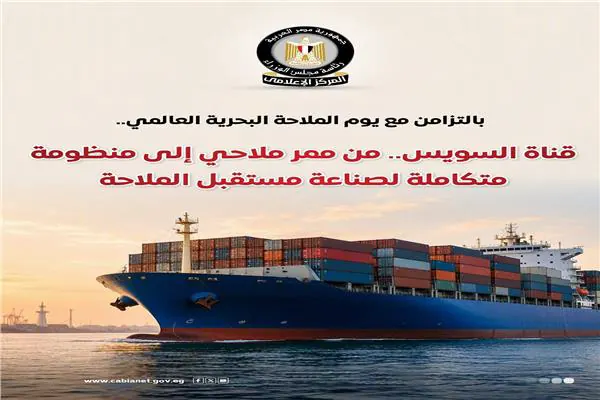
The Egyptian government has been working to develop the Suez Canal into a comprehensive maritime industry, going beyond its traditional role as a shipping lane. According to the Egyptian Cabinet's Information and Decision Support Center, the canal's strategic importance is underscored by the fact that 10% of global trade and 22% of container trade flows through it. This development is in line with the rapid changes in global shipping and aims to enhance the canal's capacity to accommodate vessels of various sizes and cargoes.
The Suez Canal has witnessed significant growth in shipping traffic during the second quarter of 2026. The number of vessels crossing the canal increased by 7.7% to 3,580, compared to 3,324 in the first quarter of 2026. The net cargo of vessels crossing the canal also rose by 14.7% to 163.9 million tons during the second quarter, up from 142.9 million tons in the first quarter. These statistics demonstrate the canal's growing importance in global trade.
The Suez Canal has also seen the passage of several large and notable vessels during the second quarter of 2026. In April, the canal was crossed by one of the world's largest cruise ships, MSC EURIBIA, measuring 331 meters in length. In May, the canal was traversed by the world's largest container ship powered by natural gas, CMA CGM GRAND PALAIS, on its maiden voyage. Additionally, the canal was crossed by the giant container ship CMA CGM VENDOME in June, also on its maiden voyage.
To enhance the canal's maritime capabilities, the Egyptian government has undertaken several development projects. The southern sector of the canal has been expanded and upgraded to improve safety, with the dredging of the canal to a depth of 72 feet and the creation of a new 10-kilometer channel in the area of the Lesser Bitter Lakes. These developments have increased the length of the dual-lane section of the canal to 82 kilometers, up from 72 kilometers, and improved safety by 28%.
The Egyptian government has also made significant investments in modernizing and expanding the canal's infrastructure. The number of crossing axes has been increased to 26, up from 10 in 2014. Furthermore, efforts have been made to transition from leasing tugboats to localizing their construction and exporting them to international markets. The construction of tugboats with a traction force of 80 tons has begun at the Port Said Shipyard, and four new tugboats of the "Azima" and "Team Azima" class have been launched.
In addition to the development of the Suez Canal, Egypt is also investing in shipbuilding and yacht construction, as well as upgrading its maritime shipyards. The South Red Sea Shipyard has been developed in partnership with the Suez Canal Authority, and two deep-sea fishing vessels, "Rizk 2" and "Rizk 3", have been launched. Moreover, maintenance work has been completed on the floating hotel "Qasr Ibrim", and a new tourist yacht produced by the Suez Canal Company for Modern Boats has been delivered.
The comprehensive development of the Suez Canal into a multifaceted maritime industry is set to further solidify Egypt's position in global trade. The ongoing investments in infrastructure, shipbuilding, and maritime services aim to increase the canal's capacity and efficiency, making it an even more attractive route for international shipping.
Key points
- The Suez Canal's expansion into a comprehensive maritime industry aims to enhance its role in global shipping and trade.
- The canal has witnessed significant growth in shipping traffic during the second quarter of 2026.
- Egypt is investing in shipbuilding, yacht construction, and upgrading its maritime shipyards to support the development of the Suez Canal.