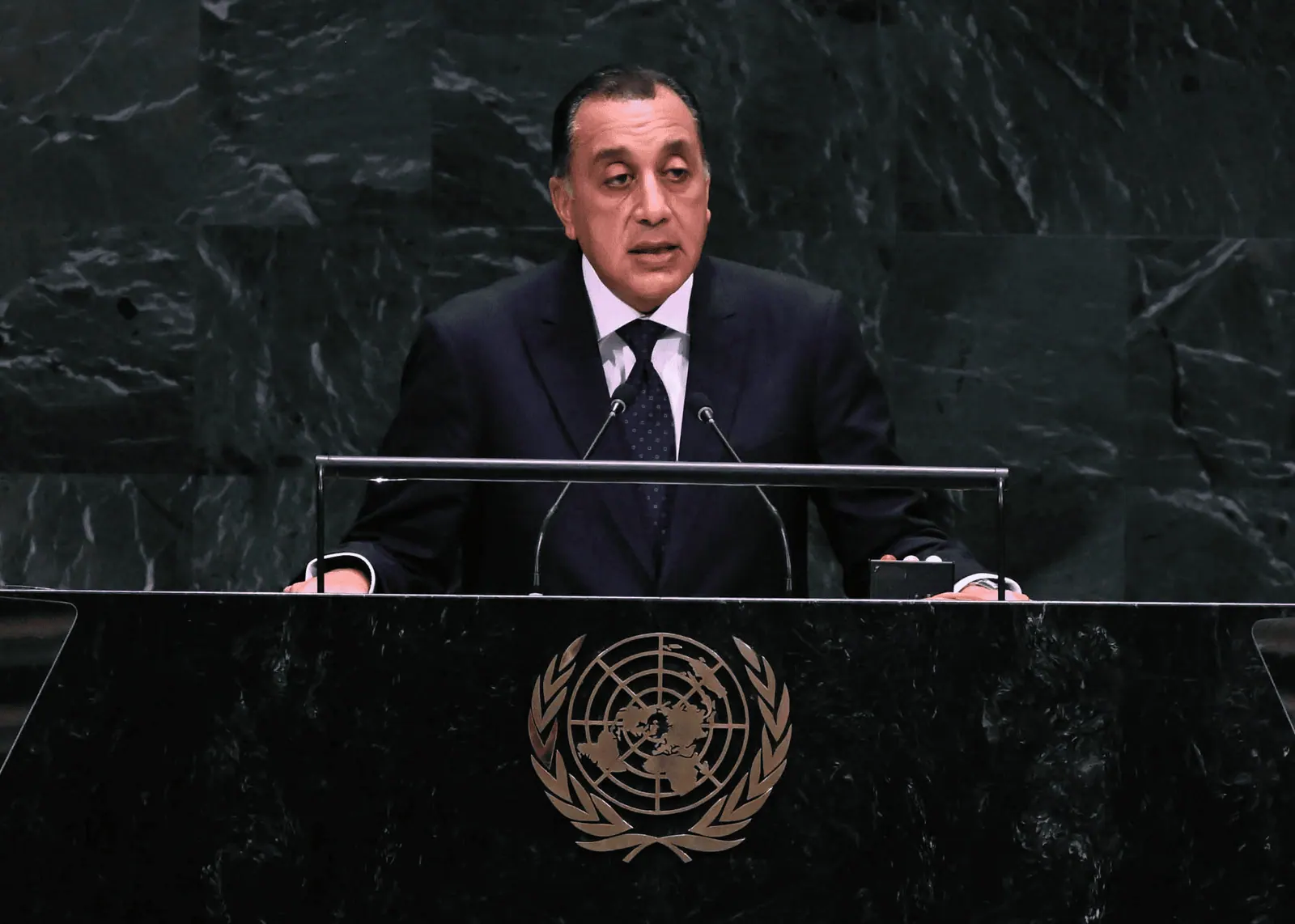
Egyptian Prime Minister Mostafa Madbouly addressed the 81st session of the United Nations General Assembly in New York on September 25, highlighting the significance of the Nile River's flow for Egypt. He described it as an "existential issue that allows for no compromise" for the Egyptian people. Madbouly emphasized that the Nile is not just an economic resource but a lifeline crucial to the existence and development of Egyptian society throughout history.
Madbouly called for a legally binding agreement to protect the rights and interests of countries sharing the Nile's waters. He advocated for cooperation, good-neighborliness, and agreements consistent with international law. The prime minister stressed that Egypt does not oppose the right of other countries to development but believes that one party's development should not come at the expense of others. He argued that water security and development are not conflicting goals when there is political will, good faith, and respect for international law.
Madbouly's comments come amid Egypt's longstanding dispute with Ethiopia over the Grand Ethiopian Renaissance Dam (GERD). Ethiopia inaugurated the dam on September 9, 2025, despite objections from Egypt and Sudan. Egypt and Sudan have called for a legally binding agreement governing the filling and operation of the dam. According to reports, Ethiopia has refused to sign such an agreement after over a decade of negotiations with Cairo and Khartoum.
The dispute over GERD has been raised at the UN Security Council. In a September 2025 letter to the Council, Egypt called for a mutually acceptable and binding agreement governing the filling and operation of the GERD. Egyptian officials have continued to frame cooperation and development as compatible goals. On September 1, Foreign Minister Badr Abdelatty and Water Resources and Irrigation Minister Hani Sewilam stated that Egypt's Nile Basin policy is based on cooperation, development, shared interests, and mutual benefit.
Madbouly also called for a stronger and more effective multilateral international system. He argued that there is a growing gap between international principles and their implementation. The prime minister emphasized the need for greater fairness in representation and decision-making, the application of international law, and access to development opportunities. He renewed Egypt's call for comprehensive reform of the UN Security Council, particularly regarding the historical underrepresentation of Africa.
In addition to the Nile water security issue, Madbouly addressed the situation in Gaza. He called for the consolidation of the ceasefire, an Israeli withdrawal, sustained humanitarian aid, and the beginning of reconstruction efforts. The prime minister reiterated Egypt's rejection of attempts to displace Palestinians from Gaza or the West Bank, including East Jerusalem. He advocated for an independent Palestinian state on the June 4, 1967 borders, with East Jerusalem as its capital, within the framework of a two-state solution.
Madbouly also discussed regional conflicts, emphasizing state sovereignty, territorial integrity, and political solutions. He reaffirmed Egypt's support for Sudan's unity and state institutions amid the country's ongoing conflict. The prime minister's speech at the UN General Assembly reflected Egypt's commitment to protecting its water security and promoting regional stability and cooperation.
Key points
- Egypt's Prime Minister Mostafa Madbouly stresses the importance of a legally binding agreement on the Nile River's waters.
- The dispute over the Grand Ethiopian Renaissance Dam has been a major point of contention between Egypt, Ethiopia, and Sudan.
- Madbouly calls for a stronger and more effective multilateral international system, including reform of the UN Security Council.