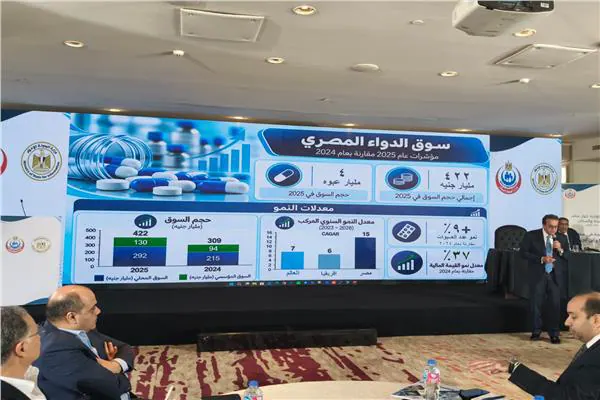
Egypt's Minister of Health and Population, Dr. Khaled Abdel Gafar, has stated that the pharmaceutical sector is a key pillar of the country's health and economic security. The government is working to support the national industry, deepen local manufacturing, and provide a safe strategic stock of medicines and raw materials. This aims to ensure the sustainability of pharmaceutical supplies for citizens and enhance Egypt's ability to become a regional hub for the pharmaceutical industry.
Dr. Abdel Gafar made these statements during a dialogue session titled "Health in Egypt: Where Are We and Where Are We Headed?" The session was attended by Dr. Diaa Rashwan, Minister of State for Information, and several editors-in-chief, program presenters, and specialized health journalists. The minister highlighted that Egypt's pharmaceutical market has become a large, independent, and promising market, with a volume of 4 billion packages worth 422 billion pounds in 2025.
The Egyptian pharmaceutical market has shown significant growth, with a 37% increase in financial value compared to 2024. This reflects the strength of the local market and the ability of the Egyptian industry to expand. The market is not only a large consumer base but also an industrial base that can be built upon to expand production and exports. This is particularly relevant given the increasing trend towards localizing modern pharmaceutical industries, transferring technology, and increasing investments in production lines.
Egypt has advanced to 26th globally in terms of the size of its pharmaceutical market in 2025, up from 30th in 2024. The strategy aims to reach the top 20 global pharmaceutical markets by 2030. In terms of exports, the Egyptian pharmaceutical industry has shifted its focus from meeting local market needs to exporting to external markets. The value of pharmaceutical exports reached 1.3 billion dollars by the end of 2025, with a target of increasing this to around 3 billion dollars by 2030.
A significant portion of Egypt's pharmaceutical exports, around 1.34 billion dollars, is directed towards African markets. Increasing pharmaceutical exports represents one of the main drivers of economic growth. The new vision extends beyond exporting locally manufactured products to establishing regional pharmaceutical manufacturing centers and complexes within the African continent. This allows for the transfer of Egyptian expertise, expansion of industrial partnerships, and enhancement of pharmaceutical security in the continent.
The Egyptian government prioritizes localizing the pharmaceutical industry as a key aspect of achieving pharmaceutical security and reducing dependence on external supply chains. The current rate of localization for pharmaceutical products in Egypt stands at around 91%. The localization plan is currently focused on the most complex stages of pharmaceutical production, with the Egyptian Drug Authority working to localize the largest 50 active raw materials that are imported.
The goal of localizing these raw materials is to build a more integrated national industrial base and reduce the risks associated with disruptions in global supply chains. The strategy also aims to expand into biological pharmaceutical industries, high-complexity products, and innovative and rare drugs. This aligns with global developments in the pharmaceutical industry and ensures the availability of safe and effective medicines for Egyptian citizens while enhancing the competitiveness of Egyptian pharmaceutical products in regional and international markets.
Key points
- Egypt's pharmaceutical market is projected to reach 422 billion pounds by 2025.
- The country aims to become a regional hub for the pharmaceutical industry by 2030.
- Egypt's pharmaceutical exports are targeted to reach 3 billion dollars by 2030.