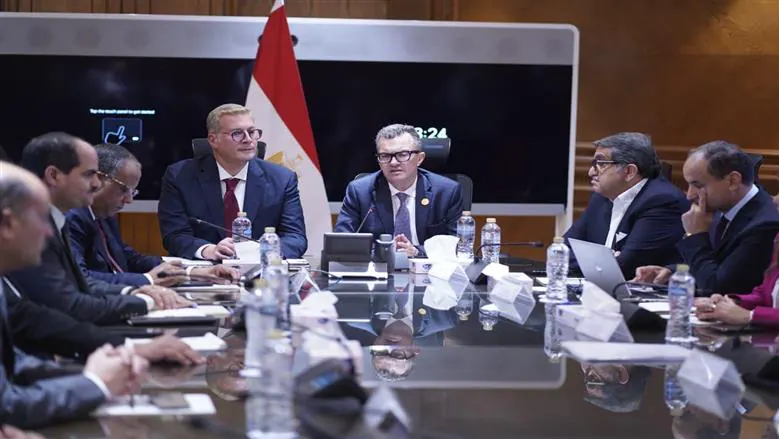
Egypt's Minister of Planning and Economic Development, Ahmed Rustom, and Minister of Petroleum and Mineral Resources, Karim Badawi, recently met to discuss the performance of the oil sector. The meeting was attended by several leaders from both ministries and focused on following up on sector indicators, increasing production, and developing investments. The ministers emphasized the importance of the oil sector in supporting the national economy and achieving sustainable development goals.
Ahmed Rustom highlighted the vital role of the oil sector in providing the local market with energy and supporting various productive and service activities. He noted that the sector's improved performance reflects its pivotal role in driving economic growth. Rustom praised the national efforts to enhance investments in the oil and energy sector, which have led to a resurgence in confidence in the investment climate. This, in turn, has opened up opportunities for increased investments in exploration and field development.
Karim Badawi stated that the oil sector is on a path of positive growth, overcoming challenges, and reflecting the Ministry of Planning's indicators. He noted that crude oil production has increased, and petroleum refining activity has grown, while the decline in natural gas production has been curbed. Badawi attributed these results to the hard work of sector employees and the settlement of outstanding dues to foreign partners, which has allowed for the resumption of necessary investments in field development and exploration.
Badawi emphasized that increasing domestic production of oil and gas is a top priority for the ministry. This will be achieved through the development of existing fields and intensifying the search for new discoveries to meet the needs of citizens and state sectors while reducing imports. He also highlighted the importance of expanding natural gas connections to homes, replacing butane gas cylinders, and converting cars to run on gas.
The minister noted that the ministry is coordinating with the Ministry of Electricity to implement the state's strategy and increase the contribution of renewable energy to electricity generation. This will reduce gas consumption and lower import costs. Additionally, projects to connect Cypriot gas fields to Egypt's infrastructure will enhance Egypt's role as a regional energy hub and maximize the economic benefits of existing facilities.
During the meeting, the ministers reviewed the growth rates of natural gas and the oil sector, which are showing positive growth. They also discussed the expansion of fuel service stations and the development of new ones to improve services for citizens. The number of fuel stations has increased significantly, from 2,900 in 2014 to 4,107 by the end of the 2025/2026 fiscal year.
The meeting concluded with a focus on cooperation between the ministries to determine priorities and support production and services for citizens. The ministers expressed their commitment to working together to drive growth and development in the oil and gas sector. Key initiatives include increasing domestic production, expanding natural gas connections, and enhancing investments in the sector.
Key points
- Egypt's oil and gas sector shows positive growth, with petroleum production and refining increasing, and natural gas output improving.
- The sector's growth is driven by national efforts to enhance investments and settle outstanding dues to foreign partners.
- Increasing domestic production of oil and gas is a top priority for the ministry to meet the needs of citizens and state sectors while reducing imports.