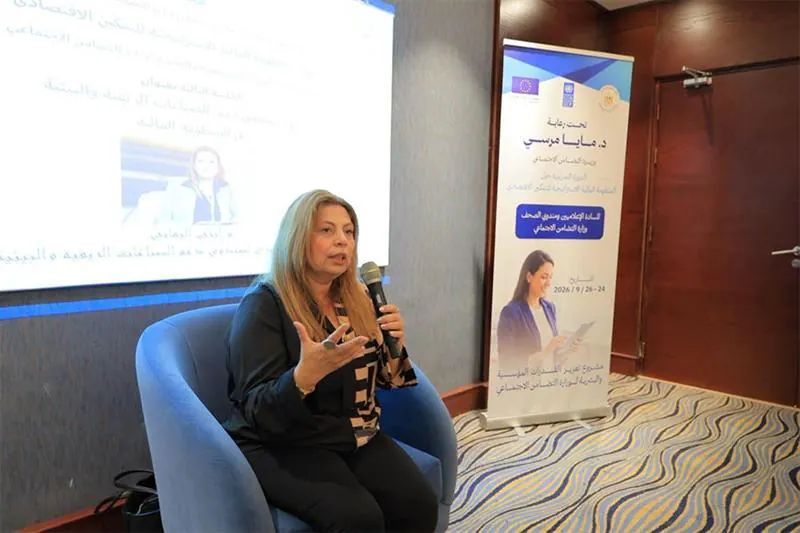
The Egyptian Ministry of Social Solidarity, led by Anji Elyamany, Executive Director of the Rural and Environmental Industries Support Fund, has introduced a new financial mechanism aimed at achieving sustainable economic empowerment. This strategy seeks to go beyond direct aid and focus on creating a more autonomous and self-sufficient economy. The approach is built on coordinating efforts among various stakeholders to provide comprehensive support to beneficiaries.
The new mechanism is designed to address the challenges faced by existing financial products and instruments in Egypt, which, despite being comparable to international standards, were scattered across multiple entities. To overcome this, a networked framework has been established, bringing together 56 partners, up from 17 at its inception. This coordination aims to prevent duplication of services, optimize available resources, and ensure a coherent follow-up of beneficiaries' progress.
The Rural and Environmental Industries Support Fund, established in 1956, plays a pivotal role in this strategy. It was one of the first Egyptian entities to integrate economic development with environmental protection, predating concepts like the green economy and climate change. The fund was restructured in late 2024 to become the operational arm of the Ministry of Social Solidarity in development and economic empowerment.
The strategy involves leveraging existing infrastructure to expand services without incurring additional costs. A partnership with the Nasser Social Bank will enable the provision of financial services through the Egyptian Post's network of 4,700 branches. Employees undergo training to ensure the delivery of these services, particularly in rural and isolated areas. The goal is to make financial services more accessible to populations with limited access to traditional banking networks.
In addition to financial services, the program offers non-financial services, including financial and digital education. Awareness programs are being implemented in villages to educate residents on the effective use of ATMs and digital financial services, while also cautioning them about fraud risks. The Fayoum governorate serves as a pilot for projects that are labor-intensive, focusing on sectors like clothing and ready-to-wear garments.
The experience in Fayoum has provided equitable income to over 2,000 women, and the ministry plans to replicate this model in other regions, including oases and the New Valley governorate. Furthermore, plans are underway to create a permanent space for artisanal and heritage products, inspired by the Indian Dilli Haat model. This initiative aims to provide artisans with regular access to consumers and markets, moving beyond seasonal artisanal exhibitions.
The Ministry of Social Solidarity's new architecture seeks to integrate financing, training, employment, production, and marketing. The objective is to gradually transition beneficiaries of aid programs towards more autonomous and sustainable economic activities. By doing so, the ministry aims to ensure the long-term sustainability of microcredit projects and empower individuals and communities economically.
Key points
- The Egyptian Ministry of Social Solidarity has launched a new financial mechanism to promote sustainable economic empowerment, focusing on rural and environmentally friendly projects.
- The strategy involves coordinating efforts among 56 partners to provide comprehensive support to beneficiaries and leveraging existing infrastructure to expand services.
- The initiative includes both financial and non-financial services, such as education and awareness programs, to support the effective use of financial services and promote economic autonomy.