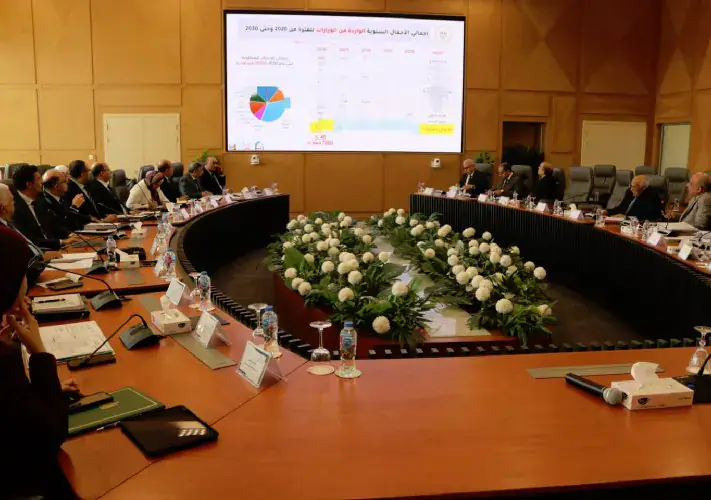
Egypt's Higher Energy Council convened its 32nd meeting to discuss the power supply needs of 11 industrial projects. The meeting, chaired by Electricity and Renewable Energy Minister Dr. Mahmoud Essmat, was attended by Industry Minister Khaled Hisham, Investment and Foreign Trade Minister Dr. Mohamed Farid Saleh, and representatives from relevant ministries and agencies. The council reviewed requests from various entities regarding the provision of electricity, natural gas, and water for several industrial activities, particularly energy-intensive industries.
The approved projects include new food industry factories in the Sadat City, tire production facilities in the Suez Canal Economic Zone, and steel industry projects in the 10th of Ramadan City. Other projects involve iron and steel production in the Sadat City and Borg El Arab City, respectively. Additionally, the council considered requests for increased power supply to existing factories, enabling them to boost production capacities and expand their industrial activities.
The council examined the energy requirements for each project, including sources of electricity and natural gas supply. They also discussed the establishment of high-voltage substations to provide the necessary power for new industrial loads. Minister Essmat emphasized that Egypt has sufficient electricity to meet various demands across all voltage levels, stressing the importance of adhering to energy efficiency standards and integrating renewable energy sources into the power mix.
The Higher Energy Council's decisions align with Egypt's National Energy Strategy, which aims to promote sustainable development and support economic and social growth. The strategy focuses on increasing the contribution of renewable energy sources to the energy mix, with a target of 45% by 2028. This goal is expected to enhance energy sustainability and meet the needs of productive sectors.
Minister Essmat highlighted the government's commitment to supporting industry, transferring technology, and localizing modern industries. He also emphasized the importance of maximizing economic returns from generated energy and exploring investment opportunities and alternatives for electricity and natural gas usage. The council's approval of power supply for the 11 industrial projects is expected to boost Egypt's industrial sector and contribute to economic growth.
The approved projects cover various industries, including iron, ceramics, and food production. The iron and steel sector is a significant consumer of energy, and the council's decision to provide power supply to new projects in this sector is expected to support the growth of Egypt's industrial sector. The ceramics and sanitary ware industry is also a major energy consumer, and the council's approval will help meet the sector's energy needs.
In conclusion, the Higher Energy Council's approval of power supply for 11 industrial projects reflects Egypt's commitment to supporting industrial growth and promoting sustainable development. The council's decisions are expected to have a positive impact on Egypt's economy and contribute to the country's goal of increasing the share of renewable energy in the energy mix.
Key points
- Egypt's Higher Energy Council approves power supply for 11 industrial projects.
- The approved projects cover various industries, including iron, ceramics, and food production.
- Egypt aims to increase the contribution of renewable energy sources to 45% of the energy mix by 2028.