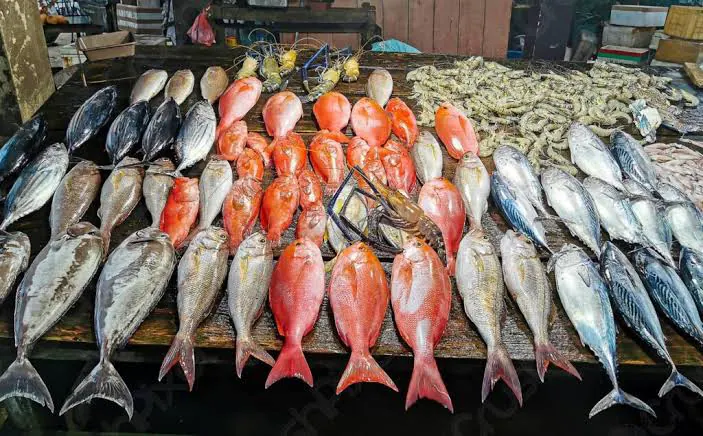
Egypt's fish market has seen stable prices on Thursday, October 1, 2026, according to fish traders. The country's aquaculture sector is the primary source of fish production, accounting for 80-85% of the total production, which stands at approximately 1.6 million tons. The remaining 15-20% comes from natural sources, including the Nile River, the Mediterranean Sea, the Red Sea, and Egyptian lakes.
The price of tilapia fish in Egypt ranges from 85 to 100 EGP, depending on the region. The country's total fish production is around 2.2 million tons per year, with 1,571,000 tons coming from aquaculture and 456,000 tons from natural fisheries. According to Dr. Salah Meiselhi, head of the General Authority for Fish Wealth Development, Egypt has made significant progress in increasing its fish production.
Other fish prices in Egypt include bouri, which ranges from 175 to 250 EGP, and sea bass, which costs between 170 and 270 EGP. The price of calamari is around 250 EGP, while eel prices range from 90 to 280 EGP. Egypt has achieved a self-sufficiency rate of 92-93.5% in fish production, thanks to the expansion of aquaculture projects.
In the Cairo Fish Market, wholesale prices for various fish types are as follows: tilapia ranges from 59 to 64 EGP per kilo, bouri from 100 to 240 EGP, and sea bass from 50 to 180 EGP. The price of eel ranges from 100 to 700 EGP per kilo. These prices are according to the official website of the Cairo Fish Market.
Frozen fish prices in Egypt vary, with frozen pasta ranging from 30 to 60 EGP per kilo. The price of frozen bouri ranges from 100 to 170 EGP, and frozen sea bass costs between 350 and 475 EGP per kilo. The average Egyptian consumes 18 kilos of fish per year, compared to the global average of 20 kilos.
Egypt's fish production is dominated by several major projects, including the Burka Ghliyon project in Kafr El Sheikh, which is one of the largest fish cities in the Middle East. The project uses the latest international standards to produce high-quality fish. Other projects include the East Suez Canal project in Ismailia, which includes thousands of fish ponds and feed factories.
Egypt has made significant investments in its aquaculture sector, with the sector starting to develop in 2015 under the guidance of President Abdel Fattah El-Sisi. The country aims to take advantage of its strategic location on the Mediterranean Sea and the Red Sea to increase fish production and meet domestic demand. Egypt currently ranks first in Africa and sixth globally in aquaculture production.
Key points
- Egypt's fish production stands at approximately 2.2 million tons per year.
- The country's aquaculture sector accounts for 80-85% of total fish production.
- Egypt has achieved a self-sufficiency rate of 92-93.5% in fish production.