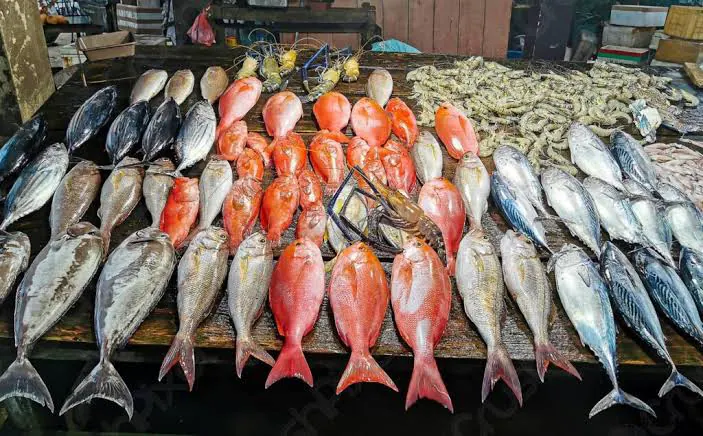
Egypt's fish market has seen stable prices on Tuesday, September 29, 2026, according to fish traders. The country's aquaculture projects have contributed to a self-sufficiency rate of 92-93.5% in fish production. This achievement is attributed to the expansion of fish farming projects, including large-scale initiatives such as the Berka Gleyon project in Kafr El Sheikh, which is one of the largest fish cities in the Middle East.
The prices of various fish types in Egypt have been reported as follows: tilapia ranges from 85 to 100 EGP per kilo, depending on the region. The country's fish production is dominated by aquaculture, which accounts for 80-85% of the total production. Egypt ranks first in Africa and sixth globally in aquaculture, thanks to its large-scale projects. The East Suez Canal project in Ismailia Governorate is one such initiative, featuring thousands of fish ponds, feed factories, and packaging facilities.
Fish prices in Egypt's Obour market, a major wholesale market, have been reported as follows: tilapia ranges from 59 to 64 EGP per kilo, while bream prices range from 100 to 240 EGP per kilo. Other fish types, such as capercaillie, are priced between 50 and 180 EGP per kilo. The prices of frozen fish in Egypt also vary, with frozen pasta ranging from 30 to 60 EGP per kilo.
The production of fish in Egypt has reached 2.2 million tons annually, with 1.571 million tons coming from aquaculture and 456,000 tons from natural fisheries. The country's per capita consumption of fish is 18 kilos per year, slightly lower than the global average of 20 kilos per year. Egypt's fish market offers a wide variety of fish, including bream, which is priced between 175 and 250 EGP per kilo.
The price of other fish types, such as mullet, ranges from 250 to 400 EGP per kilo. The Egyptian government has been promoting aquaculture since 2015, taking advantage of the country's strategic location on the Mediterranean Sea, the Red Sea, and the Suez Canal. This initiative aims to increase fish production and meet the growing demand for seafood in the country.
The Egyptian Ministry of Agriculture and Land Reclamation's efforts to develop the country's fish industry have shown positive results. The country's fish production has increased significantly, with a focus on sustainable and responsible aquaculture practices. The Berka Gleyon project in Kafr El Sheikh is a prime example of these efforts, employing advanced technologies and international standards.
The stability of fish prices in Egypt is a welcome relief for consumers and traders alike. The government's initiatives to promote aquaculture and increase fish production have contributed to this stability. With a self-sufficiency rate of 92-93.5%, Egypt is well on its way to meeting its domestic demand for fish and potentially becoming a major player in the global fish market.
Key points
- Egypt's fish prices remain stable, with tilapia ranging from 85 to 100 EGP per kilo.
- The country's aquaculture projects have contributed to a self-sufficiency rate of 92-93.5% in fish production.
- Egypt ranks first in Africa and sixth globally in aquaculture, thanks to its large-scale projects.