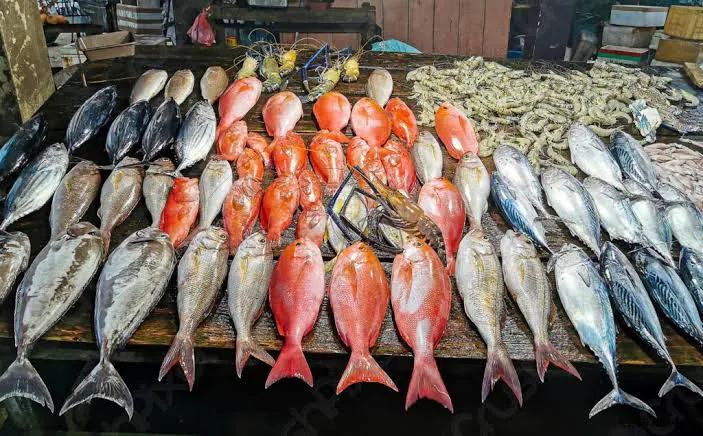
Fish traders in Egypt have reported stable fish prices on Thursday, September 24, 2026. The country's fish production has reached a significant level of self-sufficiency, ranging from 92% to 93.5%, thanks to the expansion of fish farming projects. Egypt's total fish production stands at approximately 2.2 million tons per year, with 1.571 million tons coming from fish farming and 456,000 tons from natural fisheries.
The price of Nile tilapia, a popular fish in Egypt, varies between 85 and 100 EGP per kilo, depending on the region. Other fish prices have also been reported: mullet fish are selling for between 175 and 250 EGP per kilo, while sea bass prices range from 170 to 270 EGP per kilo. The fish farming sector is the primary source of Egypt's fish production, accounting for 80-85% of the total output, which is approximately 1.6 million tons.
In the Obour market, wholesale fish prices have been reported as follows: tilapia prices range from 59 to 64 EGP per kilo, while mullet fish prices vary between 100 and 240 EGP per kilo. The prices of other fish, such as capercaillie, range from 50 to 180 EGP per kilo, and snakehead fish prices range from 100 to 700 EGP per kilo.
According to the Obour market's official website, the prices of some fish have been reported as follows: denis fish prices range from 275 to 425 EGP per kilo, while coral fish prices vary between 100 and 240 EGP per kilo. The prices of other fish, such as calamari and squid, range from 25 to 400 EGP per kilo.
Frozen fish prices in Egypt have also been reported: frozen pasta fish prices range from 30 to 60 EGP per kilo, while frozen mullet fish prices vary between 100 and 170 EGP per kilo for consumers. The price of denis fish ranges from 350 to 475 EGP per kilo.
Egypt's fish production and consumption have been steadily increasing, with the average Egyptian consuming 18 kilos of fish per year, compared to the global average of 20 kilos per year. The country's fish farming sector has been expanding rapidly, with several large-scale projects underway, including the Berka Gleyon project in Kafr El Sheikh, which is one of the largest fish cities in the Middle East.
The Egyptian government has been promoting fish farming as a way to increase the country's fish production and reduce its reliance on imports. The sector has been growing rapidly since 2015, when the government launched a program to develop fish farming in the country's marine waters. Today, Egypt ranks first in Africa and sixth globally in the fish farming sector, with several large-scale projects underway to support the sector's growth.
Key points
- Egypt's fish prices remain stable on Thursday, September 24, 2026
- The country's fish production has reached a significant level of self-sufficiency, ranging from 92% to 93.5%
- Egypt ranks first in Africa and sixth globally in the fish farming sector