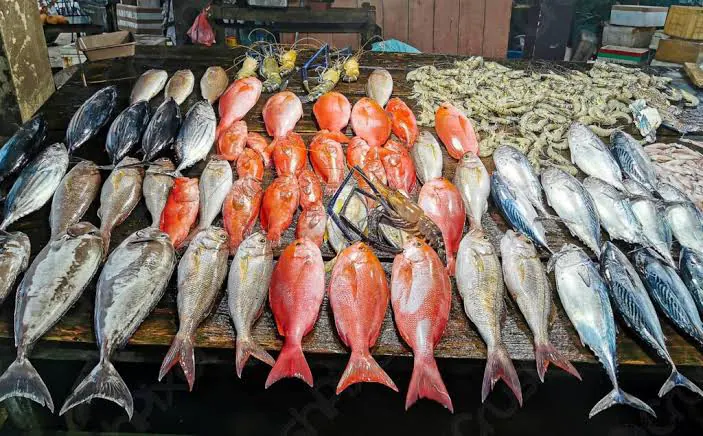
Egypt's annual fish production stands at 2.2 million tons, with 1.571 million tons from aquaculture and 456 thousand tons from natural fisheries. According to Dr. Salah Meiselhi, head of the General Authority for Fish Wealth Development, the country holds the first position in Africa and sixth globally in aquaculture. This achievement is attributed to large-scale national projects such as the Berka Ghlyoun city in Kafr El Sheikh, one of the largest fish cities in the Middle East.
The prices of fish in Egypt vary depending on the region and type. For instance, the price of flatfish ranges between 85 and 100 pounds. Other types of fish, such as bori, have prices ranging from 175 to 250 pounds per kilo. The price of calamari is between 25 and 400 pounds per kilo. These prices are based on data from Almal News and local market reports.
Egypt has made significant strides in aquaculture, with projects like the East Suez Canal in Ismailia, which includes thousands of fish ponds, feed factories, and packaging plants. Another project in the Dyiba area of Port Said comprises fish farms and hatcheries for producing shrimp and fish seeds. These initiatives aim to boost fish production and achieve self-sufficiency.
The Egyptian government initiated marine aquaculture in 2015, under the directives of President Abdel Fattah El-Sisi. This move aimed to utilize Egypt's strategic location on the Mediterranean Sea, the Red Sea, and the Suez Canal. As a result, Egypt has achieved a self-sufficiency rate of 92-93.5% in fish production.
In the Obour market, wholesale fish prices vary: flatfish costs between 59 and 64 pounds per kilo, while bori fish ranges from 100 to 240 pounds per kilo. The price of capria fish is between 50 and 180 pounds per kilo. Additionally, the price of snakes ranges from 100 to 700 pounds per kilo.
Frozen fish prices in Egypt also show variation: frozen pasta ranges from 30 to 60 pounds per kilo, while Swiss pasta costs between 100 and 170 pounds per kilo for consumers. The price of frozen denis fish ranges from 350 to 475 pounds per kilo. Egypt's per capita fish consumption stands at 18 kilograms per year, slightly lower than the global average of 20 kilograms.
The Egyptian fish market offers a wide range of fish types, including shrimp, which costs between 250 and 1000 pounds per kilo. Aquaculture remains the primary source of fish production, accounting for 80-85% of the total production, approximately 1.6 million tons. Natural sources, including the Nile River, Mediterranean Sea, Red Sea, and Egyptian lakes, contribute the remaining 15-20%.
Key points
- Egypt's fish production reaches 2.2 million tons annually.
- Aquaculture accounts for 80-85% of Egypt's fish production.
- Egypt achieves 92-93.5% self-sufficiency in fish production.